PGI-I: Patient Global Impression of Improvement
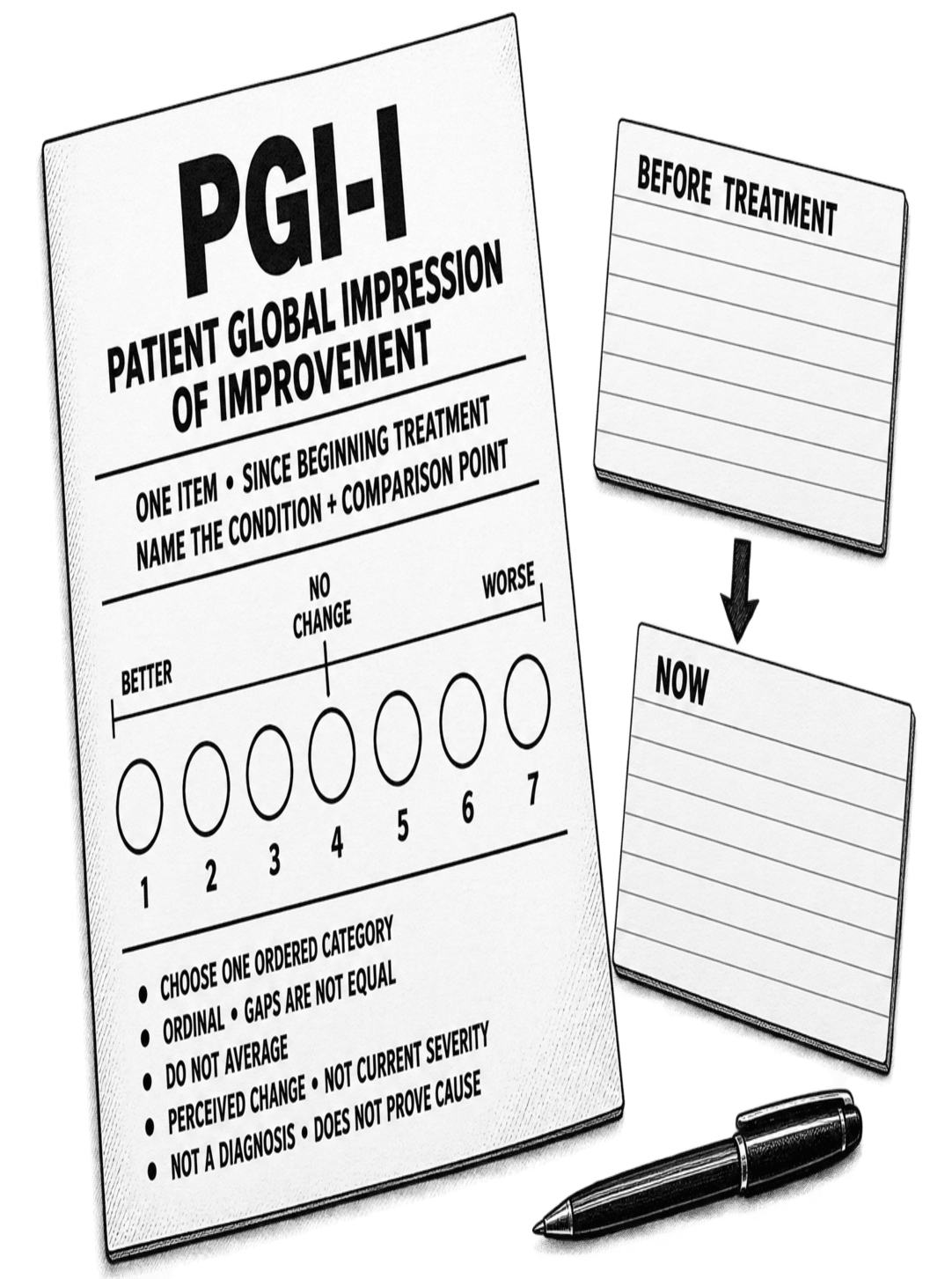
The PGI-I records one ordered 1-to-7 judgment of change. Survey Doctor’s generic condition wording is not one verified condition-specific form.
Overview
The PGI-I records one person's overall view of change since treatment began. Survey Doctor stores one category from 1 to 7, ordered from very much better to very much worse. It is not a symptom total or an evenly spaced scale. The condition and before-treatment comparison point must be clear before answering.
Introduction
The current ePROVIDE record describes a non-disease-specific Patient Global Impressions family. It notes that clinical versions have changed the item label, number of choices, and response wording.
The form must match.
Condition-specific studies do not settle one universal form. The 2003 validation studied women with stress urinary incontinence. A 2010 study studied women one year after prolapse surgery.
Survey Doctor uses a generic condition stem with seven labels. The exact source form, intended condition, and equivalence with urinary or prolapse versions remain unestablished.
The condition matters.
Name the condition before using the form. The stored numbers preserve an order, but the gap between 1 and 2 is not a measured amount equal to the gap between 4 and 5.
The intervals are unknown.
A response can support a conversation about perceived change. It cannot prove treatment success, show that treatment caused the change, or direct a treatment decision.
Perception is not causation.
Who should take this assessment?
- People whose provider has defined a specific condition and before-treatment reference
- People answering during follow-up, after treatment has begun
- People using the response alongside symptom details rather than as a stand-alone result
Note: The PGI-I is designed to be taken after treatment has begun. It is not a baseline assessment and should not be administered before the start of treatment.
No baseline belongs here.
Score interpretation
| Stored value | Response label |
|---|---|
| 1 | Very much better |
| 2 | Much better |
| 3 | A little better |
| 4 | No change |
| 5 | A little worse |
| 6 | Much worse |
| 7 | Very much worse |
One category is stored.
Labels can vary between condition-specific forms, especially in the middle categories. Use the labels printed on the selected form. The PGI-I is not a diagnostic test.
Current manual entry accepts only the seven whole-number categories. Result, report, and export paths withhold the definition's unsupported interpretation bands while retaining the selected category.
Keep the label attached.
Administration
Before answering, the person needs to know which condition and before-treatment state provide the comparison. The response is meaningful only in relation to that reference.
Timing also matters.
There is no universal repeat schedule. A provider should choose the timing and use the same condition reference each time.
Clinical applications
Condition-specific PGI-I forms can capture a patient's global view of change. A symptom questionnaire can add detail about what changed. Medical history and examination provide context that neither score contains.
Symptoms add detail.
The PGI-I already asks about change from a before-treatment state. Survey Doctor therefore does not treat repeated PGI-I values as a baseline-to-follow-up improvement trend. The stated context defines the comparison.
Do not average PGI-I values as though they were measurements on an even scale. Review each response as an ordered category, and do not use one response to continue, change, or stop treatment.
Do not average categories.
Evidence and validation
Results from one condition-specific form do not automatically apply to another condition or set of response labels. One global judgment also cannot prove that treatment caused the change. The cause and measured distance remain uncertain.
Condition-specific evidence stays specific.
Important considerations
- The PGI-I measures perceived change, not current symptom severity
- It requires a clear before-treatment reference point and named condition
- A single global rating may not capture changes in specific symptoms
- Patient expectations and recall bias can influence responses
- Its categories are ordered, but the gaps between them are not equal measurements
Related assessments
- ISI: Two-item index of leakage frequency and amount
- QUID: Screens for stress and urge incontinence response patterns
- PFDI-20: Pelvic floor symptom-bother assessment across three domains
Do not convert these categories into scores from another instrument.
Related assessment information
These pages cover related assessments. They may measure different constructs or use different populations and recall periods.
Ready to get started?
Take the PGI-I: Patient Global Impression of Improvement and gain valuable insights into your mental health
Start assessment