QUID: Questionnaire for Urinary Incontinence Diagnosis
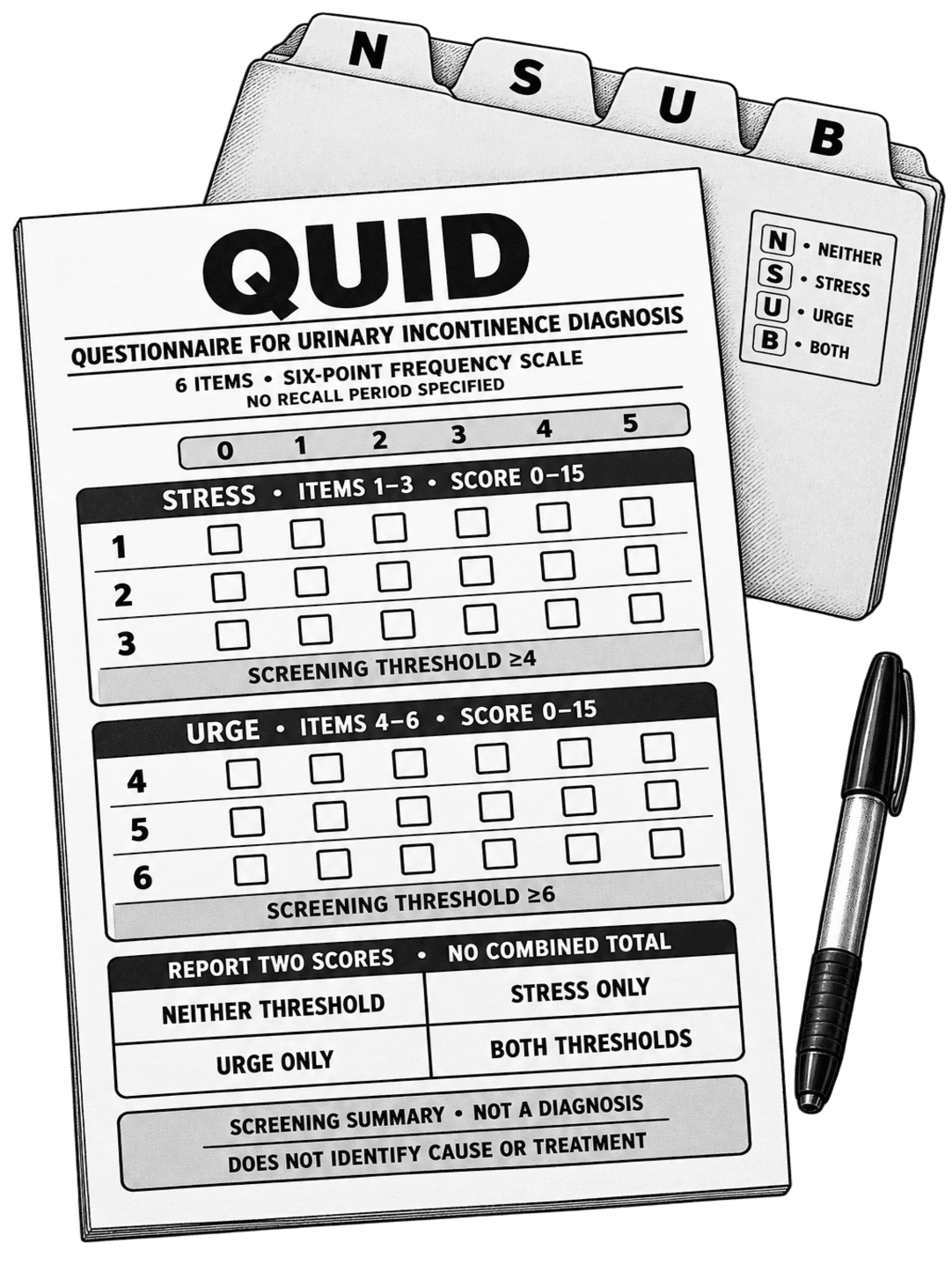
The six-item QUID reports separate 0-to-15 Stress and Urge scores, then records whether neither, one, or both screening thresholds are met.
Overview
QUID uses six frequency items to produce separate Stress and Urge scores from 0 to 15. Thresholds are 4 for Stress and 6 for Urge. Survey Doctor also stores whether neither, one, or both thresholds are met. These summaries screen urinary leakage patterns; they do not diagnose a type or select treatment.
The name says diagnosis. The result remains a screen.
What the QUID can show
Stress urinary leakage occurs with physical activity or pressure, such as coughing, lifting, or exercise. Urge leakage follows a sudden need to urinate and may occur before reaching a toilet. Some people report both patterns.
The original QUID study developed the two cutoffs in 117 women receiving urogynecologic care. It correctly classified the clinical incontinence type for about 80% of that sample. A person's history, examination, and other testing can still lead to a different conclusion.
Who should take this assessment?
- Adult women experiencing or being evaluated for urinary leakage
- Patients whose clinician wants a brief stress and urge symptom screen
- People tracking how often the six symptoms occur over time
Score interpretation
The QUID produces two separate scores. Higher numbers mean the three situations in that domain were reported more often.
Stress incontinence subscale (questions 1-3)
| Score | Interpretation |
|---|---|
| 0-3 | Below threshold: stress incontinence not suggested |
| 4-15 | Above threshold: stress urinary incontinence suggested |
Urge incontinence subscale (questions 4-6)
| Score | Interpretation |
|---|---|
| 0-5 | Below threshold: urge incontinence not suggested |
| 6-15 | Above threshold: urge urinary incontinence suggested |
Combined interpretation
| Stress score | Urge score | Screening summary |
|---|---|---|
| Below 4 | Below 6 | Neither threshold met |
| 4 or above | Below 6 | Stress threshold only |
| Below 4 | 6 or above | Urge threshold only |
| 4 or above | 6 or above | Both stress and urge thresholds |
Survey Doctor stores this four-way classification only when both domain scores are available. It does not add the two scores into a diagnostic total.
Meeting both thresholds describes a mixed screening pattern. It does not prove mixed incontinence. Clinical evaluation is still needed to identify the type and cause.
Thresholds guide the next question.
Administration
The QUID uses six frequency values from none of the time to all of the time. All six items complete one shared stem about urinary leakage. The controlling form does not specify a recall period, so Survey Doctor does not assign one.
What the questions measure
Questions 1-3 (Stress subscale): These items ask how often leakage happens during coughing or sneezing, bending or lifting, and walking, jogging, or exercise. Higher scores mean these situations were endorsed more often.
Questions 4-6 (Urge subscale): These items ask about leakage while undressing to use the toilet, leakage after a strong urge before reaching the toilet, and rushing to the bathroom because of a sudden need. Higher scores mean these situations were endorsed more often.
Clinical applications
The QUID is used in urogynecology, primary care, pelvic health, and research settings. Its two scores can organize a clinical conversation about when leakage occurs and can be repeated to track changes in symptom frequency. The scores do not identify the cause of leakage or select a treatment by themselves.
When to seek help
Consider discussing leakage with a healthcare professional if it is new, persistent, worsening, painful, accompanied by blood in the urine, or affecting daily life. A clinician can assess causes that a six-item screen cannot distinguish.
Evidence and validation
Bradley et al. (2005) studied 117 women. The Stress cutoff of 4 had 85% sensitivity and 71% specificity. The Urge cutoff of 6 had 79% sensitivity and 79% specificity. Those figures belong to that clinical sample and do not guarantee the same performance in another population, language, or setting.
Later trial research found that the separate 0-to-15 scores could also track symptom change in women receiving non-surgical treatment for stress-predominant incontinence. That does not turn a cutoff into a treatment rule.
Important considerations
- The Stress and Urge score magnitudes reflect how often their three symptoms were endorsed, while the validated cutoffs provide screening classifications rather than broad severity grades
- Some patients have mixed incontinence with both stress and urge components
- Self-reported symptoms may not match a clinical or urodynamic assessment
- The source evidence concerns women; do not assume the same classification performance in men
- A cutoff result does not establish the cause of leakage or determine treatment
Related assessments
Related assessment information
These pages cover related assessments. They may measure different constructs or use different populations and recall periods.
Ready to get started?
Take the QUID: Questionnaire for Urinary Incontinence Diagnosis and gain valuable insights into your mental health
Start assessment