NIH-CPSI: NIH Chronic Prostatitis Symptom Index
The NIH-CPSI reports pain, urinary, and quality-of-life domain scores over one week. Its nine questions produce a 0-to-43 total.
Overview
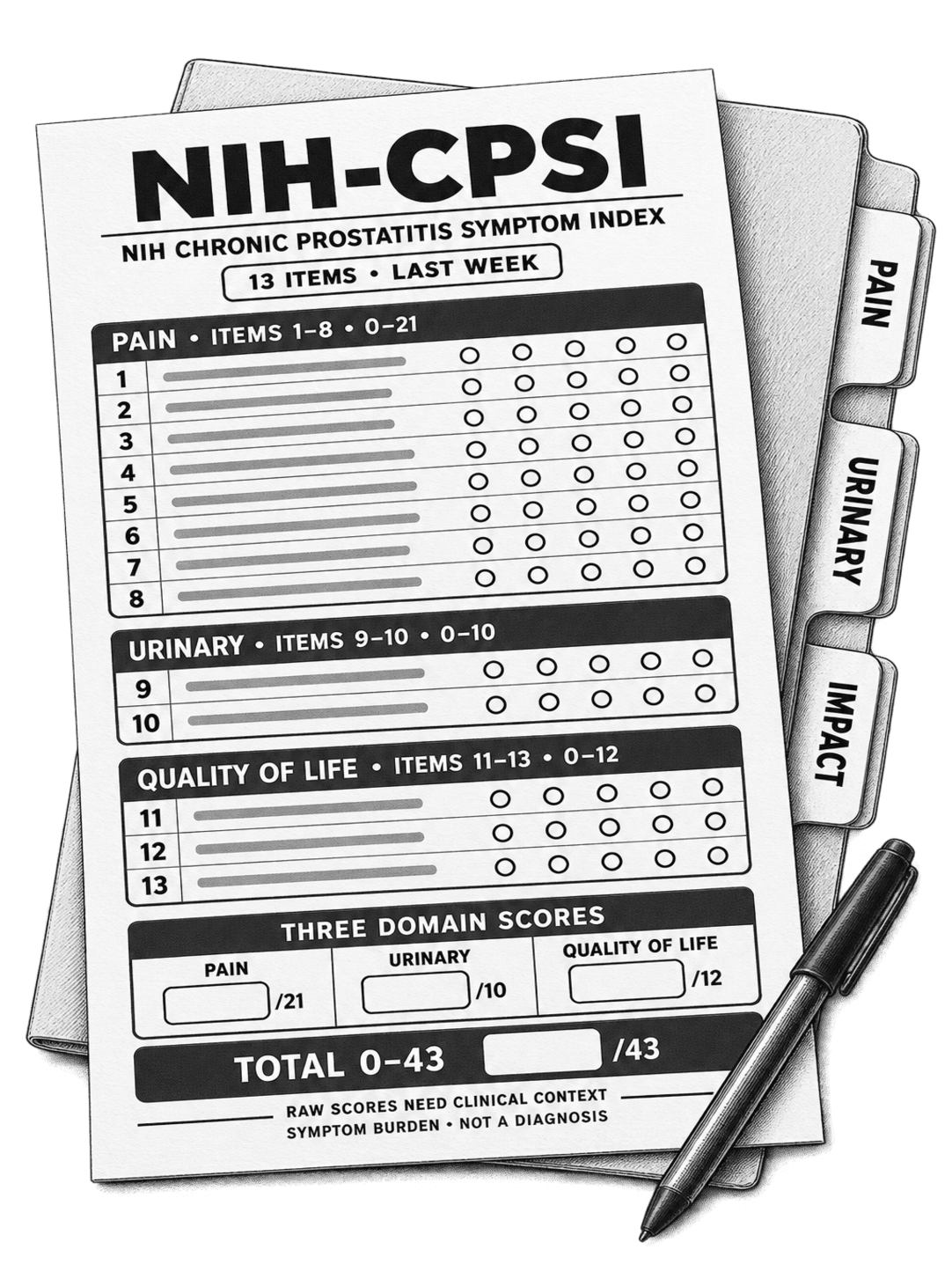
The NIH-CPSI is a nine-question measure rendered as 13 scored response rows in Survey Doctor. It covers pain, urinary symptoms, and quality-of-life impact over the last week. The three domains sum to 0-43. Scores describe burden in adult men with chronic prostatitis or chronic pelvic pain syndrome; they do not diagnose the cause.
What the NIH-CPSI can show
Chronic prostatitis / chronic pelvic pain syndrome can involve pelvic or perineal pain, urinary symptoms, and pain with ejaculation. Similar symptoms can have other causes. A doctor uses the answers alongside medical history, examination, and any needed tests.
The original development study established nine numbered questions across pain, urinary function, and quality-of-life impact. Several questions contain subparts. Survey Doctor displays those parts as 13 required response rows without changing the three-domain arithmetic.
The domains may move differently over time. Review them separately before using the total. A score alone cannot select treatment or show why a change happened.
Who should take this assessment?
- Men with persistent pelvic, perineal, testicular, or lower abdominal pain
- Men diagnosed with or being evaluated for chronic prostatitis / chronic pelvic pain syndrome (CP/CPPS)
- Men with pain during or after ejaculation, or pain with urination, lasting weeks or longer
- Men whose provider wants a structured record of symptom change over time
Score interpretation
The NIH-CPSI produces three domain scores and a total.
| Subscale | Range | What it measures |
|---|---|---|
| Pain | 0-21 | Location, frequency, and severity of pain or discomfort |
| Urinary symptoms | 0-10 | Incomplete emptying and urinary frequency |
| Quality of life | 0-12 | How much symptoms interfere with and affect daily life |
The domain scores add to a total from 0 to 43. Higher numbers reflect more reported burden on this scoring system.
Survey Doctor currently displays 0-14 as Mild symptoms, 15-29 as Moderate symptoms, and 30-43 as Severe symptoms. The reviewed sources do not establish those three total bands as one controlling NIH-CPSI standard. Treat the raw total and domains as the durable result.
Pain-label conflict at 14
Wagenlehner and colleagues classified the pain domain as mild at 0-7, moderate at 8-13, and severe at 14-21 in 1,563 clinic patients. Survey Doctor's current legacy grouping places 14 in Moderate pain and begins Severe pain at 15.
If the pain score is 14, keep the number visible and name the convention. Do not treat either label as a diagnosis or care instruction. The urinary and quality-of-life display bands in Survey Doctor also lack one source-backed grading scheme.
Administration
The pain domain includes six yes/no response rows about location and timing, one frequency response, and one 0-to-10 average-pain rating. The urinary domain has two frequency responses. The quality-of-life domain has two impact responses and one overall rating. All refer to the last week.
What the questions measure
Pain domain (questions 1-8): Identifies pain in the perineum, testicles, tip of the penis, and pubic/bladder area; pain during urination or ejaculation; how often pain occurs; and average pain intensity on a 0-10 scale.
Urinary domain (questions 9-10): Assesses the sensation of incomplete bladder emptying and urinary frequency (needing to urinate again within two hours).
Quality-of-life domain (questions 11-13): Measures how much symptoms have kept the man from his usual activities, how much he has thought about his symptoms, and how he would feel about living with the symptoms long-term.
Clinical applications
The NIH-CPSI can organize a symptom discussion and preserve the same three-domain structure across repeated assessments. Clinicians can review the domain answers instead of relying on the total alone.
Published studies use different total-score conventions. Name the convention being used, and do not let a label determine care. Compare repeated results only when the same form and scoring rules were used.
When to seek help
The questionnaire cannot determine why symptoms are present. NIDDK guidance calls for immediate care for inability to urinate, urinary pain with fever and chills, blood in urine, or severe lower-abdominal or urinary-tract pain. Arrange medical review for persistent pelvic pain or urinary symptoms.
Evidence and validation
The NIH Chronic Prostatitis Collaborative Research Network developed the measure through patient focus groups, cognitive testing, and validation against comparison groups. The 1999 study supports the nine-question, three-domain structure. Later studies support use as an outcome measure and a pain-domain convention, but they do not establish universal bands or care actions for every score.
Important considerations
- The NIH-CPSI measures symptom burden, not cause. It cannot diagnose or rule out infection, prostate cancer, or other conditions
- A bacterial cause should be excluded clinically; the index does not distinguish bacterial from non-bacterial prostatitis
- Current domain and total severity labels do not have one established controlling source
- Survey Doctor's current pain label differs from the published Wagenlehner convention at a score of 14
- Do not use a low score to rule out another condition or to stop care
- It is validated in adult men
Related assessments
Related assessment information
These pages cover related assessments. They may measure different constructs or use different populations and recall periods.
Ready to get started?
Take the NIH-CPSI: NIH Chronic Prostatitis Symptom Index and gain valuable insights into your mental health
Start assessment