ISI: Incontinence Severity Index (Sandvik Index)
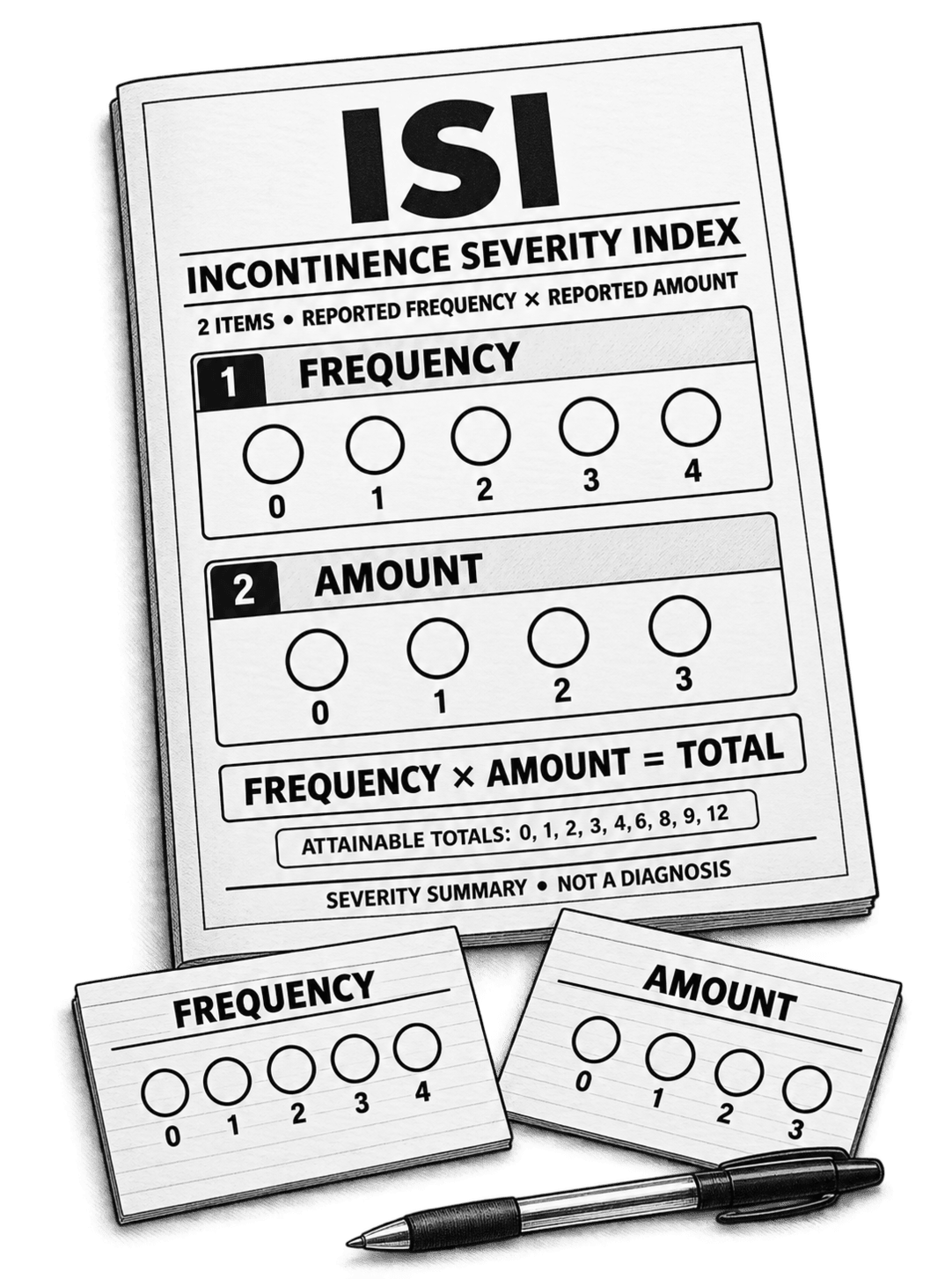
The revised ISI multiplies urinary leakage frequency by amount. Its published 0-to-12 key contains nine attainable totals and four severity categories.
Overview
The revised Incontinence Severity Index (ISI) multiplies leakage frequency by amount. Under the published key, native totals are 0, 1, 2, 3, 4, 6, 8, 9, and 12. Survey Doctor's extra zero-amount answer can also create a contradictory zero. The score grades reported leakage severity; it does not identify the type or cause.
The arithmetic is short. Its limits are not.
What the index measures
The ISI records how often urinary leakage occurs and how much urine is usually lost. It is also called the Sandvik Index. It does not ask when leakage happens, how much it affects daily life, or why it occurs.
The 2000 validation study compared the revised four-category index with 315 pad-weighing tests from 265 women. That comparison supports a brief severity measure in women presenting for care. It does not make the score an objective urine-loss measurement or validate every digital adaptation.
Who should take this assessment?
- Adult women experiencing urinary leakage, the population in the original validation work
- People whose provider wants a brief report of leakage frequency and amount
- Other adults only when a provider has considered whether the evidence fits their situation
Score interpretation
Frequency values run from 0 to 4. Positive amount values run from 1 to 3. The CDC's current NHANES implementation documents the same multiplication and four category ranges.
| Attainable total | Published category |
|---|---|
| 0 | No reported leakage |
| 1-2 | Slight |
| 3, 4, or 6 | Moderate |
| 8-9 | Severe |
| 12 | Very severe |
Scores of 5, 7, 10, and 11 cannot occur under that key. Report the attainable category rather than treating the scale as a continuous 0 to 12 range.
The ISI grades how severe urinary leakage is. It is not a diagnostic test, and it does not identify the type or the cause.
Gaps are part of the scale.
Current digital-form limitation
The CDC implementation skips the amount question when frequency is Never and offers Drops, Small splashes, or More when leakage is present. Survey Doctor currently requires both answers and adds None as an amount option. That allows daily leakage multiplied by no amount to produce 0.
The exact effect of those digital changes has not been established. Review the two answers together, and do not treat a zero from a contradictory response as verified evidence of no leakage.
Check zero at the item level.
Administration
There is no universal repeat schedule. If a provider uses the ISI over time, follow the interval they choose and answer under similar conditions.
Use the same response options and branching each time. Different forms may handle the amount question differently after a Never response, so two totals are comparable only when the administration matches.
What the questions measure
Question 1 (Frequency). How often leakage episodes occur, from never to daily.
Question 2 (Amount). How much is typically lost each time, from drops to more.
Because the two values are multiplied, a zero frequency produces a zero overall.
Clinical applications
The index offers a short way to record reported leakage frequency and amount. Repeated answers can support a conversation about change. They cannot identify the type or cause of incontinence, and a score change does not prove that a treatment caused it.
When to seek help
Talk with a healthcare provider if leakage is new, worsening, painful, or affecting daily life. Do that regardless of the score. The index does not decide whether treatment is needed or which treatment fits.
Evidence and validation
Sandvik et al. developed the original three-category index in women, then evaluated the revised four-category version in 2000. The CDC now administers the two source questions to adults aged 20 and older, but a surveillance implementation is not proof that the validation generalizes equally to every adult group.
Important considerations
- The ISI measures severity, not type. It cannot separate stress incontinence from urge incontinence
- For type, use the QUID alongside it
- Scores of 5, 7, 10, and 11 cannot occur under the published multiplication
- Very mild or infrequent leakage may score as slight and still deserve attention
- Reported frequency and amount will not match objective measurement exactly
Related assessments
Related assessment information
These pages cover related assessments. They may measure different constructs or use different populations and recall periods.
Ready to get started?
Take the ISI: Incontinence Severity Index (Sandvik Index) and gain valuable insights into your mental health
Start assessment