PROMIS Sleep Disturbance 8a (retired)
An 8-item measure of sleep quality, sleep depth, and restoration associated with sleep. Assesses perceptions of nighttime sleep experience over the past 7 days. Part of the NIH PROMIS measurement system.
Overview
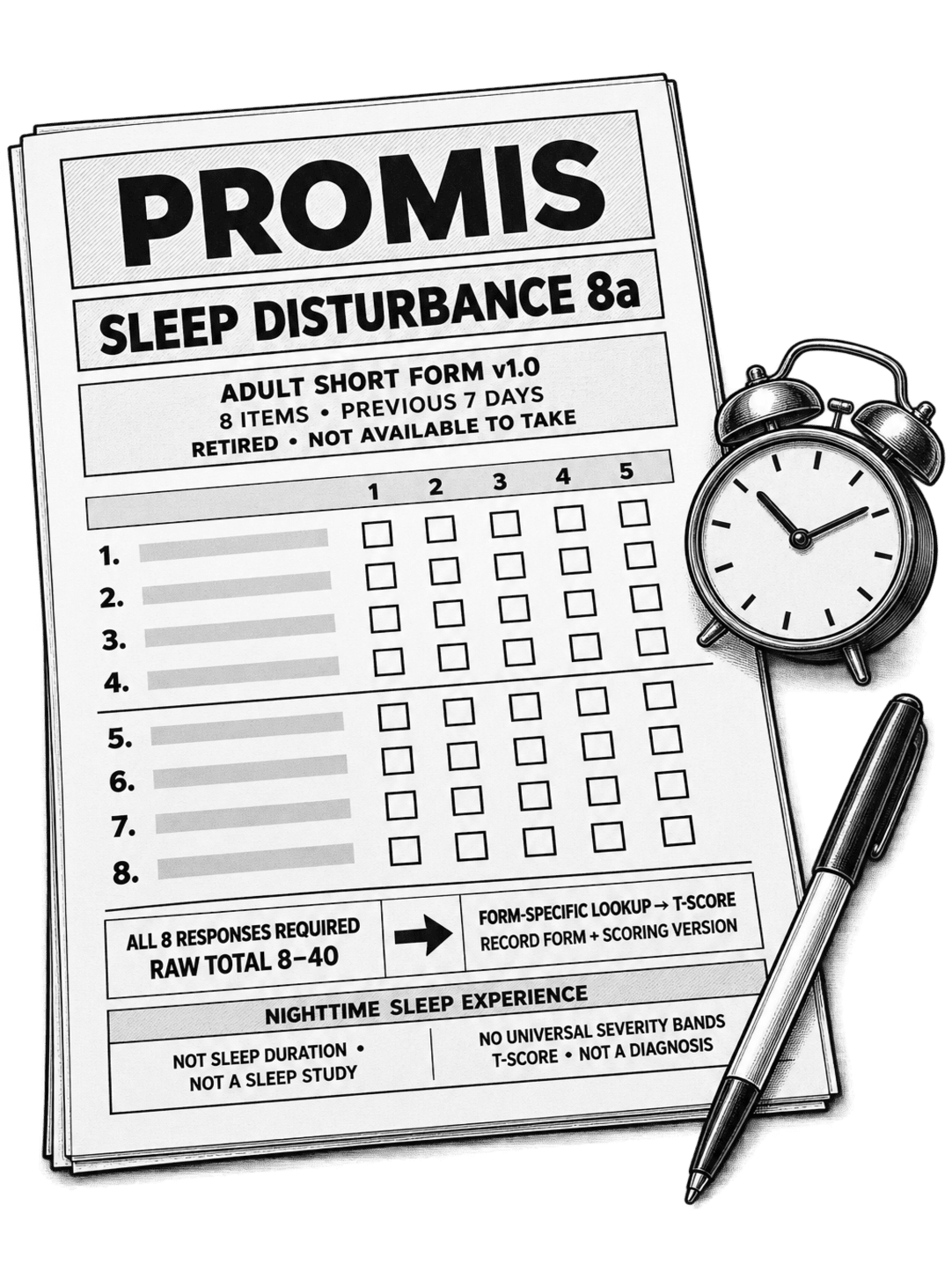
PROMIS Adult Short Form v1.0 Sleep Disturbance 8a asks about nighttime sleep during the past seven days. Survey Doctor retired it because every entry in its raw-to-T-score table conflicts with the reviewed official table. Historical numbers remain stored, but they are quarantined from interpretation, comparison, trends, and primary exports.
The form is unavailable to take.
What this questionnaire measures
The official respondent form has eight self-report items. They focus on the experience of sleep at night, including:
- Overall sleep quality
- Whether sleep felt refreshing
- Trouble falling asleep
- Restless sleep
- Effort and worry around sleep
- Satisfaction with sleep
The questionnaire records a person's nighttime sleep experience. It does not measure sleep duration or directly detect breathing interruptions, limb movements, or other events recorded in a sleep study.
How scoring works
Each completed item contributes a value from 1 to 5. Two positively worded items have reversed stored values, so higher raw totals consistently represent more sleep disturbance.
All eight items must be answered. Their values add to a raw total from 8 to 40, which is converted with the table for this exact form and scoring version.
The current HealthMeasures sleep scoring manual maps a complete raw total of 8 to a T-score of 30.5 and 40 to 77.5.
The retired digital table maps those same endpoint totals to 28.9 and 83.8. All 33 raw-total mappings differ from the reviewed sleep-specific table. Another official profile manual gives 77.6 rather than 77.5 at the upper endpoint, leaving a conflict between official sources.
Survey Doctor treats the historical T-score and its label as unverified instead of substituting a new value silently. Do not treat a current or historical Survey Doctor T-score as a verified PROMIS result.
A PROMIS T-score is not a diagnosis. This page does not publish universal severity bands or clinical thresholds because interpretation depends on the selected reference and clinical purpose.
The PROMIS Sleep Disturbance scoring review gives plain guidance for readers who received an older result.
If you have an older Survey Doctor result
Keep the result with its date, form name, scoring version, and item responses when available. Compare it with another PROMIS result only when the same form and scoring method were used.
If the version is missing, a clinician or research team should decide whether the record is suitable for comparison. A score without its item responses may not be recoverable under another scoring method.
When all item answers remain available, a later verified correction may support rescoring after a formal history decision. A score-only record cannot be corrected from the T-score alone.
Sleep Disturbance and Sleep-Related Impairment
PROMIS separates two related experiences:
| Measure | Main focus |
|---|---|
| Sleep Disturbance | Nighttime sleep quality and difficulty |
| Sleep-Related Impairment | Daytime alertness, tiredness, and functioning |
The two forms answer different questions. A person can report poor sleep at night without the same degree of daytime difficulty, or the reverse. Their T-scores are not interchangeable.
When symptoms matter more than a score
You do not need a questionnaire score to discuss persistent sleep problems with a healthcare provider. Mention symptoms that affect daily life, such as repeated difficulty sleeping, waking unrefreshed, loud snoring, gasping, or daytime drowsiness.
Avoid driving or operating equipment if you cannot stay alert. A score cannot make that situation safe.
Related assessment information
These pages cover related assessments. They may measure different constructs or use different populations and recall periods.
Register interest
Tell us which survey interests you. We will contact you if it becomes available on Survey Doctor.
Contact us