STOP-Bang sleep apnea screening
What the eight-factor STOP-Bang screen measures, how its 0-to-8 score and additional high-risk rule work, and what each risk group means.
What this assessment is
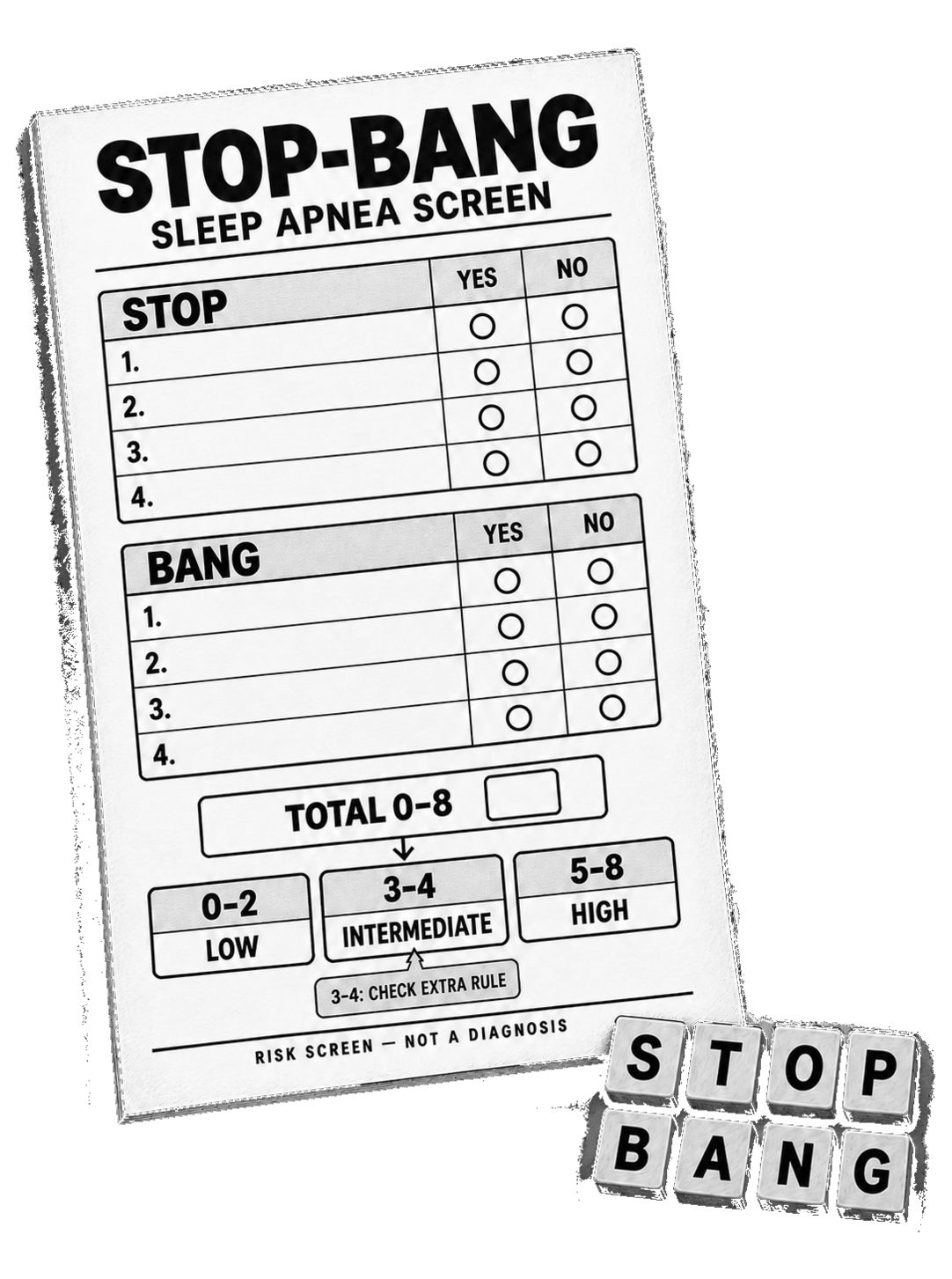
STOP-Bang adds eight yes-or-no risk factors for a total from 0 to 8. The general-population rules classify totals of 0 to 2 as low risk, 3 to 4 as intermediate risk, and 5 to 8 as high risk.
The result estimates risk of obstructive sleep apnea, or OSA. It does not diagnose sleep apnea or measure its severity.
Its name combines four symptom questions, called STOP, with four background factors, called Bang.
Frances Chung and colleagues developed the measure for surgical patients and published the original validation study in 2008.
Who it was designed for
STOP-Bang was first validated in adults attending preoperative clinics. It has since been studied in sleep clinics, surgical groups, and general populations.
A high score is common in groups where OSA risk factors are common. The original preoperative evidence does not establish identical performance in every community or clinical group.
This page covers the current eight-factor adult scoring method. Modified versions and population-specific rules need separate evidence.
How it is administered
STOP-Bang records eight factors:
- snoring
- tiredness or daytime sleepiness
- observed breathing pauses
- high blood pressure
- body mass index
- age
- neck circumference
- sex recorded as male in the original scoring rule
Each factor is scored yes or no. The symptom factors are reported, while the other factors use demographic or physical information.
Use all eight factors. Do not replace a missing factor with no.
What it measures
STOP-Bang combines OSA symptoms with demographic and physical risk factors. It is designed to identify people who may need closer assessment or diagnostic testing.
The Berlin Questionnaire also estimates OSA risk, but it uses three scored categories. The ESS measures daytime sleepiness and does not include the other OSA risk factors.
No one questionnaire covers the full clinical assessment.
The sex factor is part of the original algorithm. NICE notes concerns about STOP-Bang accuracy in women and less common presentations. Treat that factor as one part of the assessment, not a rule-out.
How scoring works
Give one point for each positive factor. Add the eight points for a total from 0 to 8.
The current official scoring guide uses these basic groups:
- 0 to 2: low risk
- 3 to 4: intermediate risk
- 5 to 8: high risk
There is also an additional high-risk rule. A person with at least two positive STOP symptom factors is high risk if they also have any one of these: male sex, body mass index above 35, or neck circumference above 40 centimetres.
Apply that rule as written. A total of 3 or 4 can therefore move from intermediate to high risk.
How to interpret a STOP-Bang score
A higher result means that more OSA risk factors are present. It does not mean that breathing events are more severe in a fixed one-point step.
Low risk does not mean no risk. High risk does not confirm OSA.
Use the result with the person's symptoms, medical history, airway examination, sleep opportunity, medicines, and the reason for screening. The threshold for further testing can differ between a preoperative clinic and general primary care.
NICE guidance recommends considering STOP-Bang alongside a preliminary assessment when OSA is suspected.
If you are struggling to stay awake while driving, stop driving and seek medical advice. Do not wait for a higher score.
What the score cannot tell you
STOP-Bang cannot diagnose OSA, count breathing events, measure oxygen loss, or distinguish obstructive from central sleep apnea.
It also cannot explain tiredness or snoring. Those symptoms can have several causes.
The score can be high because of age, body measurements, sex, or blood pressure even when symptoms are limited. It can be lower in someone whose risk is not well represented by the original factors.
Do not use it as a stand-alone decision to start or rule out treatment.
Evidence and limitations
The original study found high sensitivity for moderate and severe OSA in a surgical population. Later research supported the screen in several settings but also showed its central tradeoff: it identifies many at-risk people and can produce many false positives.
A practical scoring study added the combined high-risk rule for people with totals of 3 or 4. That rule improves risk separation without turning the questionnaire into a diagnostic test.
The American Academy of Sleep Medicine guideline states that questionnaires should not diagnose OSA without polysomnography or an appropriate home sleep apnea test.
Use the exact scoring version and record all eight factors.
Related assessment information
These pages cover related assessments. They may measure different constructs or use different populations and recall periods.
Register interest
Tell us which survey interests you. We will contact you if it becomes available on Survey Doctor.
Contact us