PSQI: Pittsburgh Sleep Quality Index
What the 19-item Pittsburgh Sleep Quality Index measures, how its seven components produce a 0-to-21 global score, and what a score above 5 means.
What this assessment is
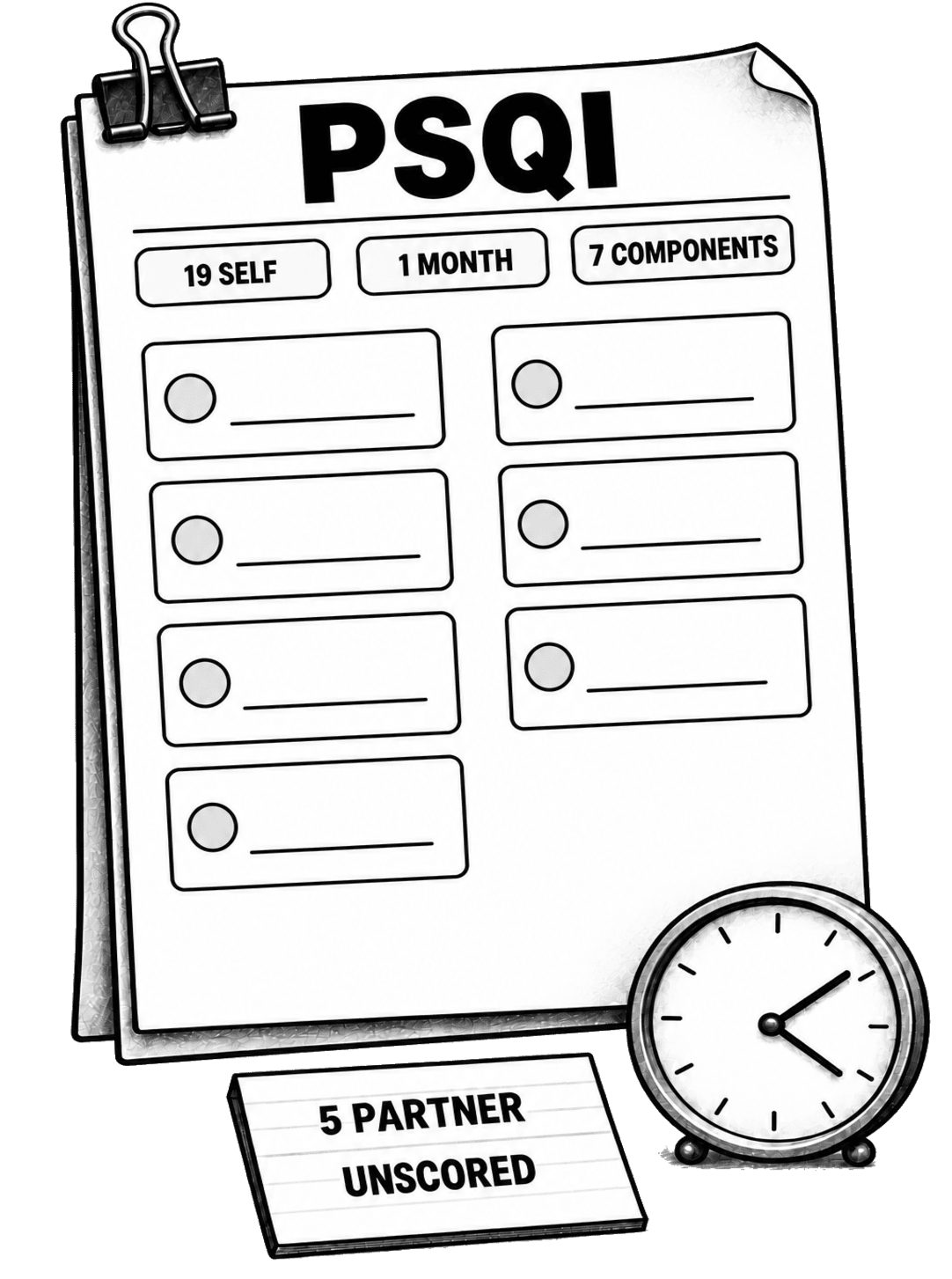
Nineteen self-rated Pittsburgh Sleep Quality Index responses produce seven component scores and a 0-to-21 global total. In the original study, a total above 5 marked poor sleepers. It is not a diagnosis or a severity band.
The PSQI describes sleep quality and sleep problems over the past month. The standard form also has five questions for a bed partner or roommate, but those do not contribute to the score.
Daniel Buysse and colleagues introduced the PSQI in a 1989 study.
The PSQI describes a broad pattern of sleep. It does not diagnose a sleep disorder.
Who it was designed for
The original study included adults described as good sleepers, people with depression, and patients with sleep disorders. Later research has used the PSQI in clinical, community, occupational, and research settings.
Age, health, medication, work schedule, language, culture, and the reason for assessment can affect sleep and the meaning of a result.
This page covers the original adult form and its standard global score. Short forms and adapted versions need their own scoring rules and evidence.
How it is administered
The respondent reports their usual sleep during the past month. Questions cover clock times, sleep duration, sleep difficulties, medicine use, daytime problems, and overall sleep quality.
The form uses different response formats. Some answers are times or durations. Others use frequency or quality ratings.
Those responses must be converted with the PSQI scoring rules. It is not a straight sum of 19 answer values.
The optional bed-partner or roommate questions add context only. Do not include them in the global score.
Use the full past-month form when comparing a result with standard PSQI evidence.
What it measures
The PSQI produces seven component scores:
- subjective sleep quality
- sleep latency
- sleep duration
- habitual sleep efficiency
- sleep disturbances
- use of sleeping medicine
- daytime dysfunction
Each component covers a different part of sleep. Two people can have the same global total for different reasons.
The ISI focuses more narrowly on perceived insomnia severity and impact. The ESS measures daytime sleepiness. The MEQ describes preferred timing for sleep and activity.
How scoring works
Convert the 19 self-rated responses into the seven standard components. Each component scores from 0 to 3.
Add the seven component scores for a global total from 0 to 21. Higher totals indicate poorer reported sleep quality.
The official scoring article defines the component calculations. Several require more than one response, and habitual sleep efficiency requires clock-time and duration calculations.
Missing responses can make one or more components impossible to calculate. The reviewed standard sources do not establish one universal replacement method. Report incomplete data instead of treating blanks as zero.
How to interpret a PSQI score
In the original study, a global score above 5 distinguished participants described as poor sleepers from those described as good sleepers.
That is a screening boundary from a specific study. It is not a diagnosis and does not create official mild, moderate, or severe bands.
Do not turn 0 to 5, 6 to 10, and 11 to 21 into a severity system unless a separate source validates that exact use for the target population.
Review the global total with the seven component scores. A high sleep-latency component raises a different question from a high medicine-use or daytime-dysfunction component.
What the score cannot tell you
The PSQI cannot identify the cause of poor sleep. It cannot distinguish insomnia from sleep apnea, circadian disruption, pain, medication effects, depression, environmental problems, or insufficient sleep opportunity.
It also cannot replace objective testing when a clinician needs information about breathing, movement, sleep stages, or physiological sleep time.
A score of 5 or less does not rule out a sleep disorder. A score above 5 does not establish one.
Evidence and limitations
The original study found good reliability and clear differences between its good-sleeper and patient groups. The PSQI became a common research measure because it covers several sleep domains in one form.
A systematic review found that the PSQI has extensive measurement evidence, but its accuracy and best cutoff vary by population and study design.
The measure relies on recall and perception over a month. Reported times can differ from sleep diaries or laboratory results.
Scoring also needs care. Component conversions, clock-time calculations, missing responses, and adapted versions can all change the total.
Keep the seven components visible whenever possible.
Related assessment information
These pages cover related assessments. They may measure different constructs or use different populations and recall periods.
Register interest
Tell us which survey interests you. We will contact you if it becomes available on Survey Doctor.
Contact us