WHO-5 Well-Being Index
What the five-item WHO-5 measures, how its 0-to-25 raw score converts to a percentage, and what a score below 13 means.
What this assessment is
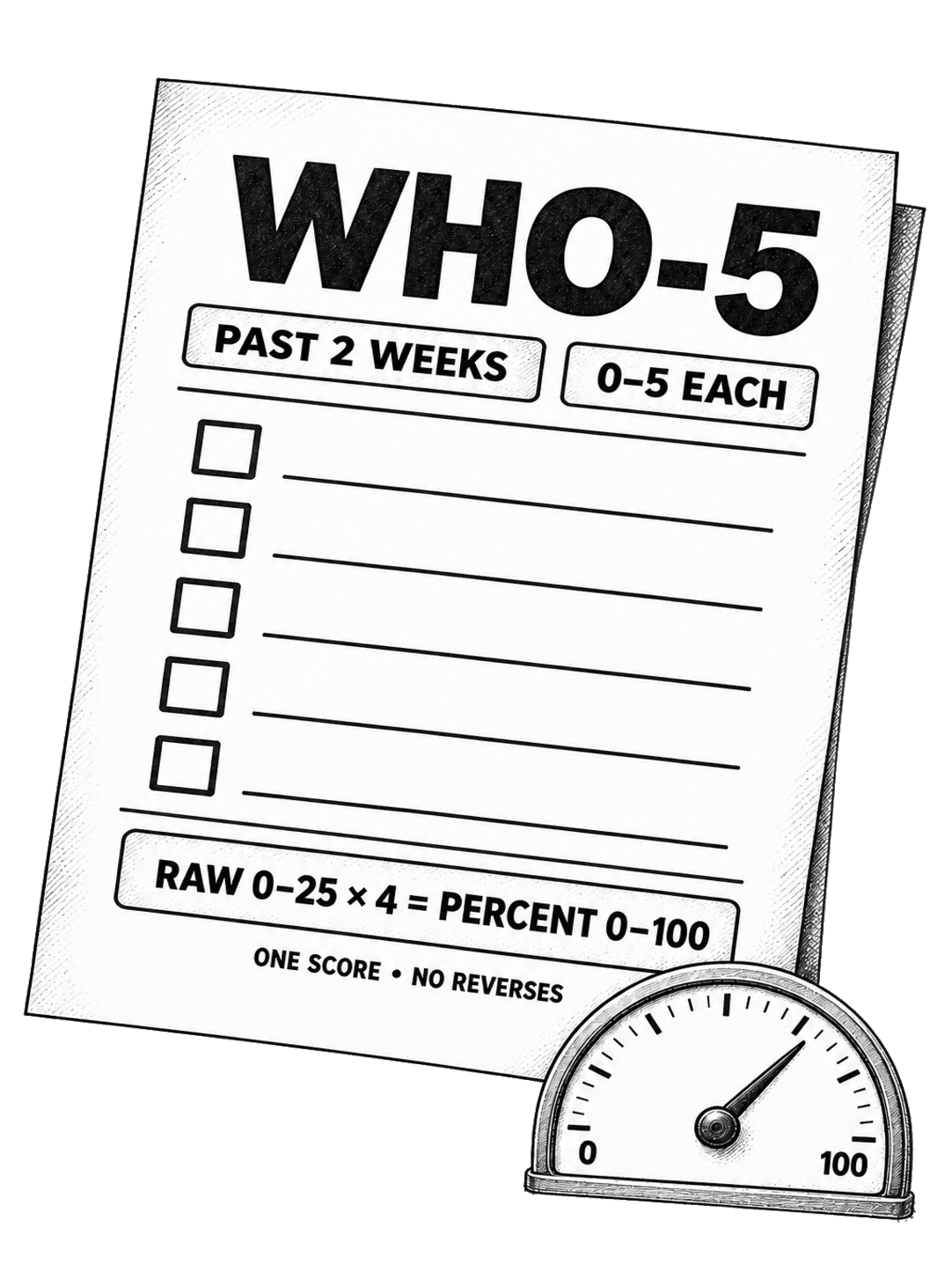
The five-item WHO-5 measures positive mental wellbeing over the past two weeks. Its raw total runs from 0 to 25 and can be multiplied by 4 for a percentage score from 0 to 100. WHO says a raw score below 13, or below 50%, has been suggested as a reason for further assessment.
The World Health Organization's current publication provides the standard form and scoring method.
Who it was designed for
The WHO-5 has been used with adults in healthcare, public health, workplace, and research settings. Studies also include younger and older groups.
Use in a specific population needs a suitable translation and supporting evidence because a score cannot be assumed to have the same meaning across every language, age group, culture, or health condition.
How it is administered
The standard form asks about the past two weeks, with each of its five items scored from 0 to 5 and none reverse scored.
Keep the timeframe and response scale unchanged. A different recall period or response system creates a modified measure.
WHO's 2024 form does not state a missing-response rule. For population surveys, OECD's 2025 guidance says not to calculate a WHO-5 total when any response is missing. Do not impute a value.
What it measures
The WHO-5 measures recent positive mental wellbeing. It reports one overall score rather than separate scores for individual experiences.
It does not count depression symptoms directly. Low positive wellbeing and high depression symptoms are related but not identical.
The Satisfaction with Life Scale measures a different part of subjective wellbeing: a broad judgment of life satisfaction rather than recent positive mental wellbeing.
How scoring works
Add the five responses for a raw total from 0 to 25.
Higher totals indicate better reported wellbeing. Multiply the raw total by 4 to produce a percentage score from 0 to 100.
For example, a raw total of 15 becomes a percentage score of 60, with both numbers describing the same responses on different scales.
Do not compare 15 and 60 as if they were different results. State whether a reported number is the raw or percentage score.
How to interpret a WHO-5 score
The standard WHO form says that a raw score below 13 is below 50 on the percentage scale. It describes this boundary as a suggested indication of poor mental wellbeing and reason for further assessment.
This is a screening threshold, not a diagnostic boundary. A score of 12 does not prove depression, and a score of 13 does not rule it out.
Small differences near the threshold should not be overread. Interpretation should also consider changes over time, daily function, current stressors, physical health, and the person's own concerns.
When tracking change, use the same language, timeframe, and scoring scale each time.
What the score cannot tell you
The WHO-5 cannot identify a mental health condition, explain why wellbeing is low, or show which type of support would help.
Low wellbeing has many possible causes, including mental or physical illness and difficult circumstances. The score alone cannot distinguish them.
A high score does not rule out a specific problem. Positive wellbeing and clinically important symptoms can exist at the same time.
Evidence and limitations
A 2015 systematic review examined 213 articles and found broad use of the WHO-5 across clinical fields, as a depression screen, and as an outcome measure.
Broad use is not the same as identical performance everywhere because study methods, translations, populations, and purposes vary.
The WHO-5 is useful when the question is recent positive wellbeing, but it is too brief to replace a symptom assessment, diagnostic interview, or review of safety and daily function.
Related assessment information
These pages cover related assessments. They may measure different constructs or use different populations and recall periods.
Register interest
Tell us which survey interests you. We will contact you if it becomes available on Survey Doctor.
Contact us