WEMWBS: Warwick-Edinburgh Mental Well-being Scale
What the 14-item WEMWBS measures, how its 14-to-70 total works, and why population context matters when interpreting it.
What this assessment is
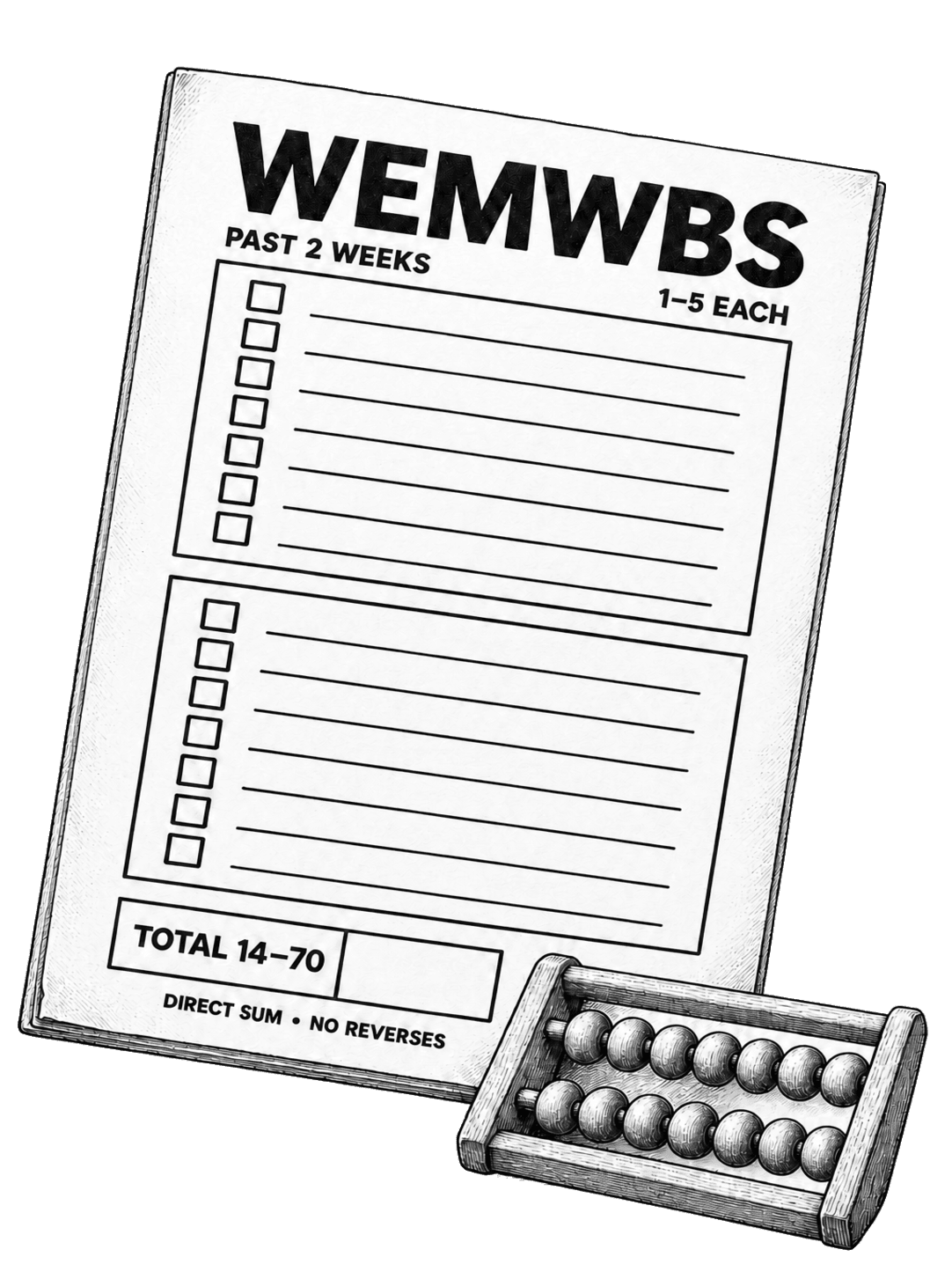
WEMWBS is a 14-item self-report measure of positive mental wellbeing over the past two weeks. Add the 14 responses for a total from 14 to 70. Higher totals indicate greater wellbeing, but a WEMWBS total is not a diagnosis or an immediate safety assessment.
Researchers at the Universities of Warwick and Edinburgh developed the scale with NHS Health Scotland, then tested it in UK university students and a representative Scottish population sample in the original validation study.
WEMWBS combines positive feelings with psychological and social functioning. The output is one total.
Who it was designed for
The original work focused on people aged 16 and older in the United Kingdom. Later studies have tested particular translations and populations, but findings do not transfer automatically between versions.
Use a validated version for the respondent's language and population. A translation that sounds natural is not necessarily psychometrically equivalent.
WEMWBS is used in population research and service evaluation. It is not a crisis or diagnostic assessment.
How it is administered
WEMWBS has 14 positively worded statements. The respondent rates their experience during the past two weeks using five scored response levels.
It is designed for self-completion. The current Warwick guidance notes that reading the measure aloud can produce more positive answers, so administration method should remain consistent.
Use the full 14-item form and its standard timeframe. The seven-item short form is scored differently and should not be treated as a simple half-length substitute.
What it measures
WEMWBS covers both positive emotional wellbeing and positive functioning. It does not measure the symptom criteria for one specific disorder.
The SWEMWBS is a seven-item short form derived from WEMWBS. The WHO-5 is shorter still and focuses on recent positive wellbeing with a different set of questions and scoring rules.
How scoring works
Each response scores from 1 to 5. Add all 14 values for a total from 14 to 70.
Higher totals indicate greater positive mental wellbeing. All items point in the same direction, so there is no reverse scoring.
All 14 responses are required for the standard total. Zero cannot replace a missing answer. Do not prorate.
Report that the result comes from the 14-item WEMWBS. SWEMWBS differs: its raw score requires a nonlinear conversion, so neither its raw nor metric score is interchangeable with this total.
How to interpret a WEMWBS score
No universal cutoff exists. Treat the total as a continuous measure of positive mental wellbeing.
Because norms differ by population, distributions can help describe where a score sits within a relevant group. According to Warwick's UK reference material, the population mean was 51.0 with a standard deviation of 7 (guidance). Those figures provide context, not a diagnostic or treatment threshold.
For outcome tracking, use the same version and administration method. A responsiveness study produced individual-change estimates from 3 to 8 points depending on the statistical method. Because those estimates differ, 3 points should not be treated as a universal personal threshold.
Do not label a person as mentally ill or well from this score alone.
What the score cannot tell you
WEMWBS cannot diagnose depression, anxiety, bipolar disorder, or another condition. It does not assess immediate risk or explain why wellbeing is low or changing.
A low total may reflect symptoms, physical illness, loss, isolation, financial strain, or other pressures. A high total does not rule out a serious symptom that the scale does not ask about.
A clinical assessment needs direct questions about symptoms, daily function, context, and safety.
Evidence and limitations
The original UK study found support for a single wellbeing factor in its analyses and expected links with related health measures.
An independent 2023 Rasch study in English-speaking U.S. community adults found that the 14-item scale was poorly targeted to that sample. Population fit remains important.
WEMWBS provides a broad positive-wellbeing total. It cannot show which specific area drove the score or distinguish a lasting change from a short-term shift without repeated measurement and context.
Related assessment information
These pages cover related assessments. They may measure different constructs or use different populations and recall periods.
Register interest
Tell us which survey interests you. We will contact you if it becomes available on Survey Doctor.
Contact us