SWEMWBS: Short Warwick-Edinburgh Mental Well-being Scale
What the seven-item SWEMWBS measures, why its raw 7-to-35 total needs conversion, and how to interpret the metric score.
What this assessment is
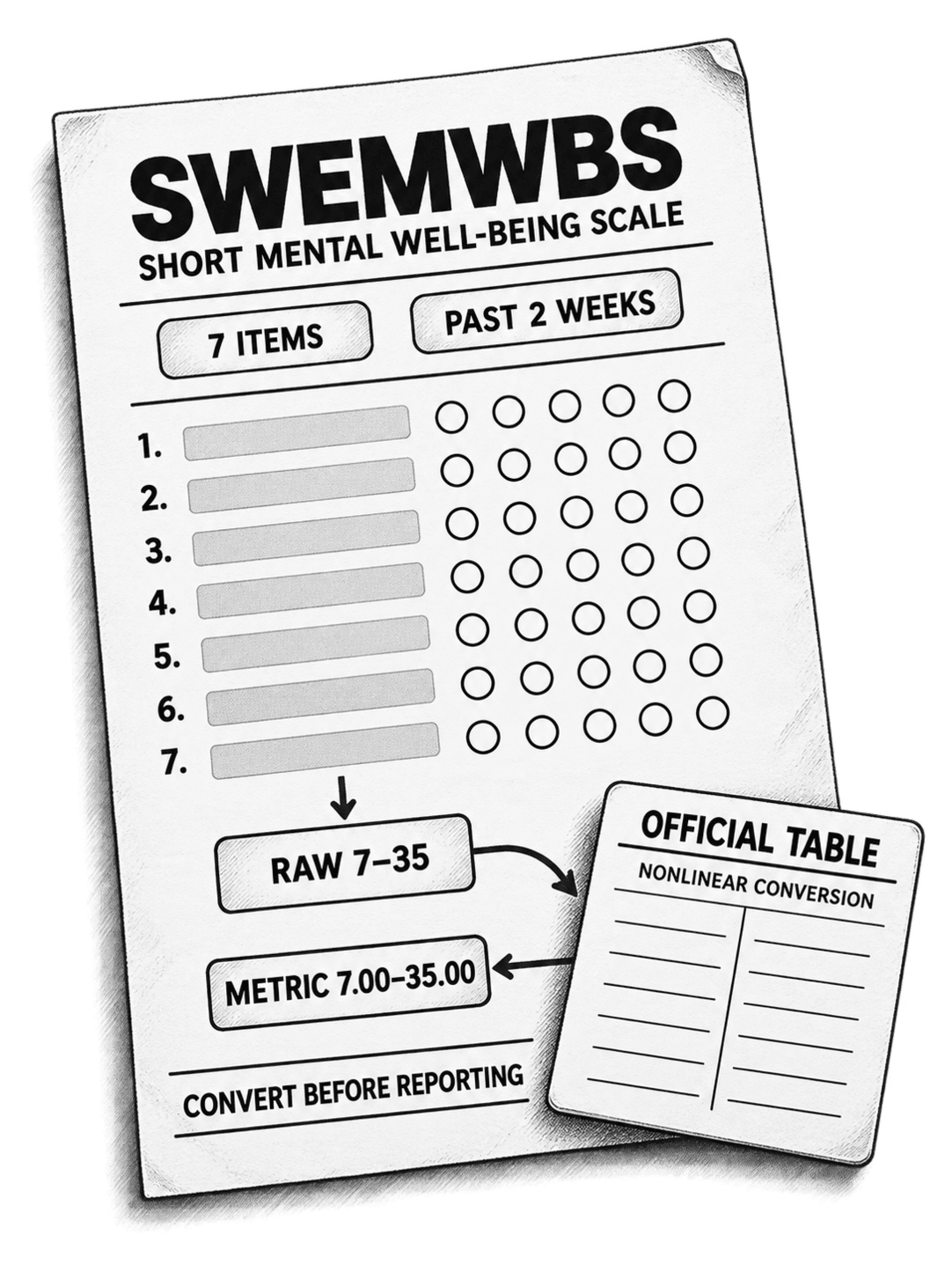
The Short Warwick-Edinburgh Mental Well-being Scale (SWEMWBS) measures positive mental wellbeing over the past two weeks. Its seven items produce a raw total from 7 to 35, but that total must be converted with Warwick's official table before it is reported as a metric score.
Researchers derived SWEMWBS from the 14-item WEMWBS using Rasch analysis, a statistical method that tests whether items work together as a measurement scale. The original short-form study found better fit for the selected seven items in its Scottish sample.
The result describes positive functioning and wellbeing. It does not diagnose a mental health condition.
Who it was designed for
The short form was derived from Scottish population data from 779 respondents aged 16 to 74. It is used in population monitoring, research, and service evaluation.
Evidence from one country or language does not establish the same score meaning everywhere. Use a validated translation and norms that fit the population when possible.
The original adult evidence starts at age 16. Evidence should be checked separately before applying the form to younger groups.
How it is administered
SWEMWBS has seven positively worded statements and five scored response levels. The respondent considers the past two weeks.
It is designed for self-completion. Keep the method consistent across repeated assessments because assisted or interview administration can change how people respond.
Use the exact seven-item short form. Selecting seven responses from a WEMWBS result without applying the official scoring method does not produce a standard SWEMWBS metric score.
What it measures
SWEMWBS focuses mainly on positive psychological functioning. It covers a narrower construct than the full WEMWBS and places less emphasis on emotional aspects of wellbeing.
The WEMWBS has 14 items and a broader balance of positive feelings and functioning. Their raw score ranges are not comparable. Choose the form based on its purpose and the evidence available for your population.
Neither form directly measures the symptoms required for a psychiatric diagnosis.
How scoring works
Each response scores from 1 to 5. Adding all seven values gives a raw total from 7 to 35.
That raw total is not the final score used in the Rasch-based system. Raw and metric scores are not interchangeable. The official nonlinear table produces a metric score from 7.00 to 35.00, and equal raw-score changes do not always produce equal metric-score changes.
Use Warwick's official conversion table. Do not report the raw sum as a metric score or invent a linear conversion.
All seven responses are required. Do not convert an incomplete raw sum or replace a missing response with zero.
How to interpret a SWEMWBS score
SWEMWBS has no universal diagnostic cutoff. Higher metric scores indicate greater positive mental wellbeing.
Use the metric score for research comparisons, population norms, and change over time. State clearly whether a number is raw or converted.
National reference values can provide context. Warwick reports a UK general-population mean metric score of 23.5 with a standard deviation of 3.9. Ng Fat et al.'s national norms study used Health Survey for England data from 27,169 adults aged 16 and older. These figures describe a reference population, not a diagnostic threshold.
The public evidence does not establish a single change threshold that proves meaningful improvement for every person using the standard two-week form. Keep the version, recall period, and administration method consistent when comparing scores.
What the score cannot tell you
SWEMWBS cannot identify depression, anxiety, trauma, or another condition. It does not assess immediate safety or explain why wellbeing changed.
One total can hide different response patterns. It also leaves out many social and physical factors that affect wellbeing.
A low score can support a broader conversation. A high score does not rule out serious symptoms that the short form does not measure.
Evidence and limitations
The original Rasch analysis supported the short form as a single measurement scale in the sample studied. It also showed that SWEMWBS and WEMWBS do not cover exactly the same breadth of wellbeing.
The short form has fewer items than WEMWBS, but its conversion step adds a common source of error when software treats the raw sum as the final score.
Interpret results with the exact version, scoring method, population, and purpose in view.
Related assessment information
These pages cover related assessments. They may measure different constructs or use different populations and recall periods.
Register interest
Tell us which survey interests you. We will contact you if it becomes available on Survey Doctor.
Contact us