SPS: Social Phobia Scale
How the 20-item Social Phobia Scale is scored from 0 to 80, what a higher total means, and how SPS differs from SIAS and LSAS.
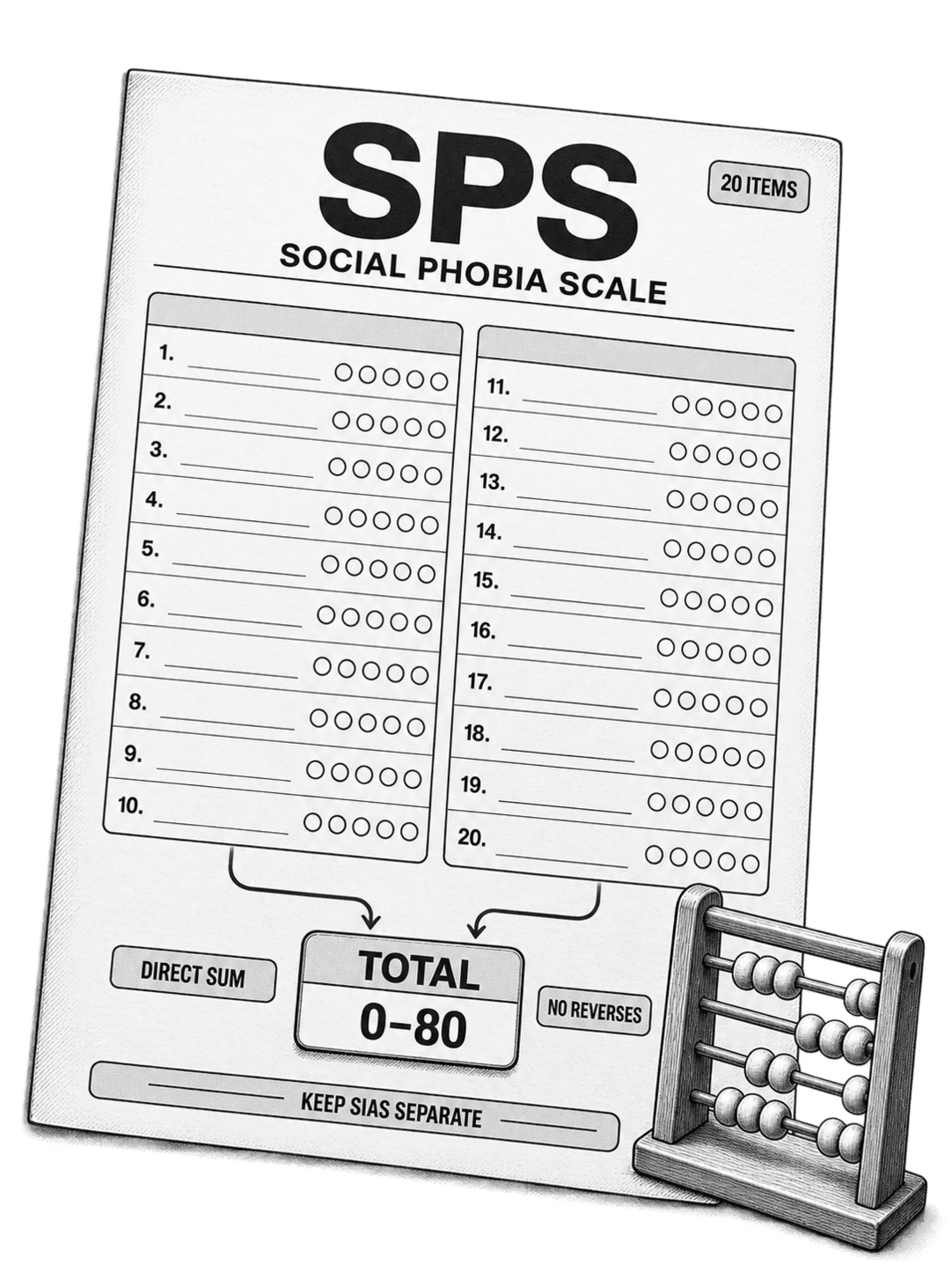
The 20-item Social Phobia Scale (SPS) measures anxiety about scrutiny and observed performance. Responses score from 0 to 4, with no reversals. Adding the 20 values produces a total from 0 to 80. Higher totals indicate more scrutiny fear, but no universal severity bands apply. The SPS cannot diagnose social anxiety disorder.
What the SPS measures
Richard Mattick and Christopher Clarke developed the SPS with the Social Interaction Anxiety Scale. Their 1998 paper separates scrutiny and observed-performance fears from anxiety during direct social interaction.
The SPS focuses on anxiety and self-consciousness when another person may be watching, evaluating, or noticing a visible sign of anxiety. Its focus is narrower than social anxiety disorder as a whole.
The original research included adults with social phobia, adults with other anxiety conditions, and community participants, so results from one clinical, student, community, language, or cultural group should not be treated as universal norms.
How it is administered
The SPS is an adult self-report measure. No fixed recent recall window applies. Its response choices describe how characteristic each statement is of the respondent.
The reviewed standard form has 20 responses and a 0-to-4 scale. SPS-6, SPS11, translated forms, and other modifications have separate evidence and scoring contracts.
How scoring works
Add all 20 values for a total from 0 to 80. Higher totals indicate more reported fear of scrutiny or observed performance.
No values are reversed. Do not apply the SIAS reversal rule to the SPS. An independent study of both scales confirms the 20-response form and its 0-to-80 range.
The reviewed sources did not provide a universal replacement or proration rule for missing responses. Missing values are not zero, and an incomplete form is not a standard SPS total unless a validated protocol specifies the method.
Keep the SPS total separate from the SIAS total. A combined 0-to-160 score is not standard scoring unless a research protocol explicitly defines and supports that analysis.
How to interpret an SPS score
A higher total means that the respondent reports more anxiety about being observed or scrutinized. Review the score with the activities causing distress or avoidance, functional impact, and the person's circumstances.
There is no single SPS cutoff: an Oxford assessment guide suggests 24 or higher, while a Dutch validation reported decision points of 15 or higher for men and 18 or higher for women. These values came from different populations and purposes, so they are not universal severity bands or diagnoses.
For repeated measurement, keep the version, language, instructions, and administration method the same. A change in total does not by itself explain what changed or prove meaningful recovery.
SPS, SIAS, and LSAS answer different questions
The SIAS focuses on meeting and talking with people. The clinician-administered LSAS covers a wider set of social and performance situations and gives separate fear and avoidance ratings.
These measures overlap, but their content and scoring differ. Their totals are not interchangeable.
What the result cannot establish
The SPS cannot confirm or rule out social anxiety disorder, identify the cause of the ratings, or select treatment. A low total can miss one severe performance fear, and a high total does not provide a complete account of avoidance or functioning.
Related assessment information
These pages cover related assessments. They may measure different constructs or use different populations and recall periods.
Register interest
Tell us which survey interests you. We will contact you if it becomes available on Survey Doctor.
Contact us