LSAS: Liebowitz Social Anxiety Scale
How the 24-situation clinician-administered LSAS is scored from 0 to 144, what its fear and avoidance totals mean, and how it differs from LSAS-SR.
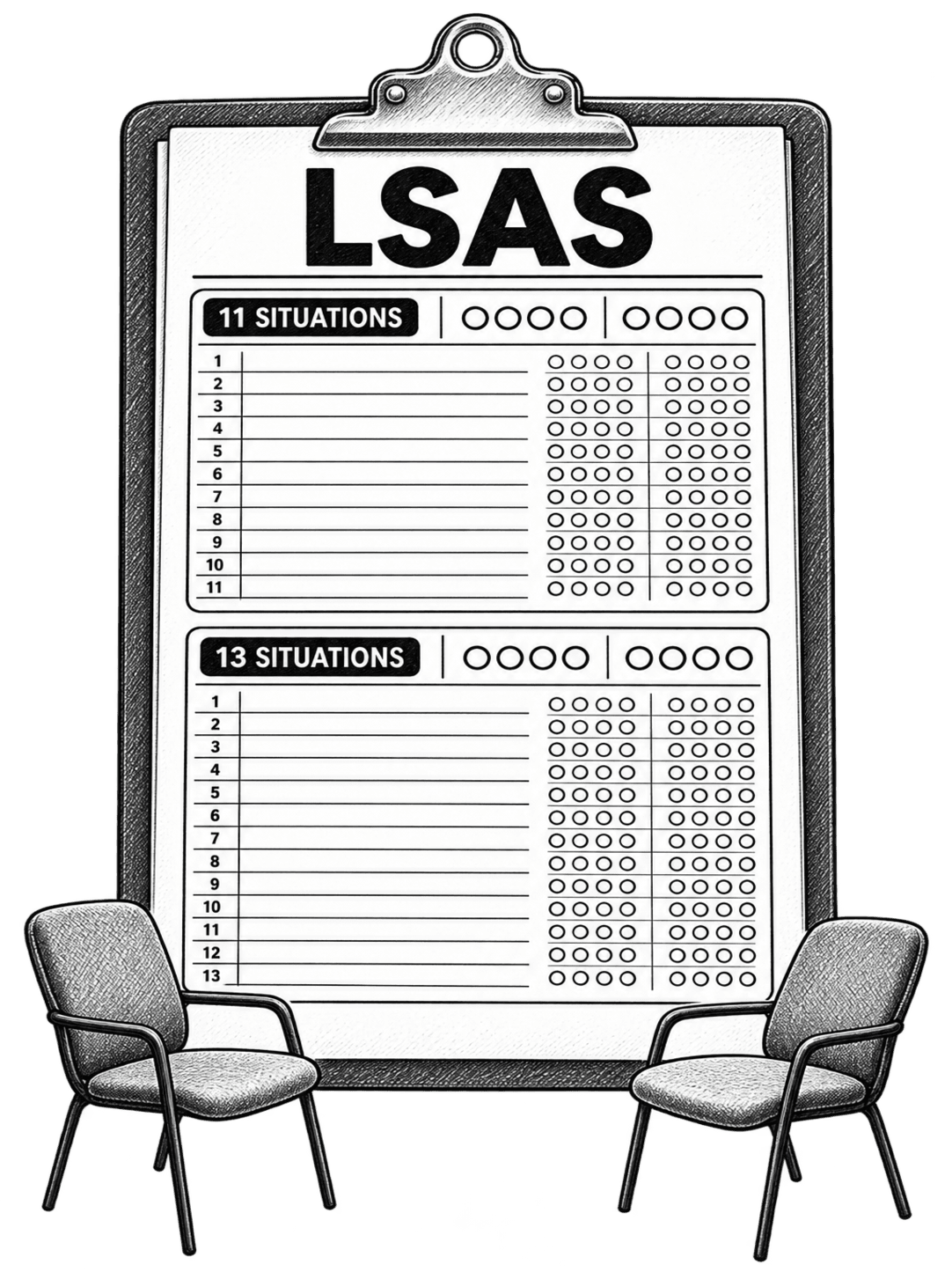
The original clinician-administered Liebowitz Social Anxiety Scale (LSAS) rates fear or anxiety and avoidance across 24 social and performance situations over the past week. Each rating runs from 0 to 3. The usual global score is 0 to 144, with separate 0-to-72 fear and avoidance totals. It measures severity and change, not diagnosis.
How LSAS scoring works
The author's 2003 guide describes several ways to summarize the clinician-administered scale.
| Score | What is added | Range |
|---|---|---|
| Global LSAS | Fear and avoidance across all 24 situations | 0–144 |
| Fear or anxiety | Fear ratings across all 24 situations | 0–72 |
| Avoidance | Avoidance ratings across all 24 situations | 0–72 |
| Social | Fear and avoidance across 11 social situations | 0–66 |
| Performance | Fear and avoidance across 13 performance situations | 0–78 |
The guide also permits four narrower scores. Social fear and social avoidance each run from 0 to 33. Performance fear and performance avoidance each run from 0 to 39.
Higher scores reflect more rated social fear or avoidance, but the global total alone cannot distinguish a few very high ratings from a broader pattern of moderate ratings. Keep the component scores identifiable.
The reviewed sources supply no LSAS replacement or proration rule for missing ratings. All published ranges assume that every situation has both ratings, so do not report an incomplete form as a standard total without an authorized protocol.
Clinician LSAS and LSAS-SR are different formats
Michael Liebowitz developed the original LSAS as an adult clinician-rated measure. The current ePROVIDE instrument record identifies it as a clinician-reported outcome and lists LSAS-SR and the child and adolescent version as related forms.
During the interview, the clinician checks the person's understanding, reviews the past week, and uses the guide's conventions when a situation did not occur. The process uses clinical judgment rather than simply recording a self-completed list.
The LSAS-SR is a separate form. Delivery method alone does not identify the version, so confirm whether a result is clinician-rated or self-reported and record its recall period and scoring range.
What an LSAS score means
Interpret the LSAS as a continuous measure of social anxiety-related fear and avoidance. The subscore pattern shows whether fear, avoidance, social interaction, or performance situations contributed more to the total.
There is no universal set of online severity bands. Older studies proposed decision points for particular clinical samples and diagnostic distinctions. Those values do not turn the scale into a diagnosis and should not be transferred to another population without supporting evidence.
A low global total can also hide one narrow but severe fear. Review the situations causing distress or interference alongside the numbers. For repeated measurement, keep the version, recall period, rater method, and situation definitions consistent.
How LSAS differs from SIAS and SPS
The SIAS focuses on anxiety during social interaction. The SPS focuses on scrutiny and observed performance. The LSAS covers both areas and gives separate fear and avoidance ratings for every situation.
These scales overlap, but their totals are not interchangeable. They differ in content, respondent, administration, and scoring range.
What the result cannot establish
The LSAS cannot confirm or rule out social anxiety disorder, identify the cause of the ratings, or replace a diagnostic assessment. It also does not select treatment or provide a complete account of functioning or immediate safety.
Evidence and limitations
A large clinician-version study found that LSAS scores related more strongly to other social-anxiety measures than to depression measures and changed during treatment research. An independent study of 97 African American adults with anxiety disorders supported the clinician format while finding that fear and avoidance were highly related and that proposed factor models fit imperfectly. Neither study establishes universal population norms.
A self-report validation study supported the LSAS-SR as a separate format. The LSAS-SR, child and adolescent versions, and translations require their own version-specific evidence. Always match a comparison with the exact name, language, respondent, and scoring contract.
Related assessment information
These pages cover related assessments. They may measure different constructs or use different populations and recall periods.
Register interest
Tell us which survey interests you. We will contact you if it becomes available on Survey Doctor.
Contact us