SIAS: Social Interaction Anxiety Scale
How the commonly used 20-item Social Interaction Anxiety Scale is scored from 0 to 80, what a higher total means, and how it differs from SPS and LSAS.
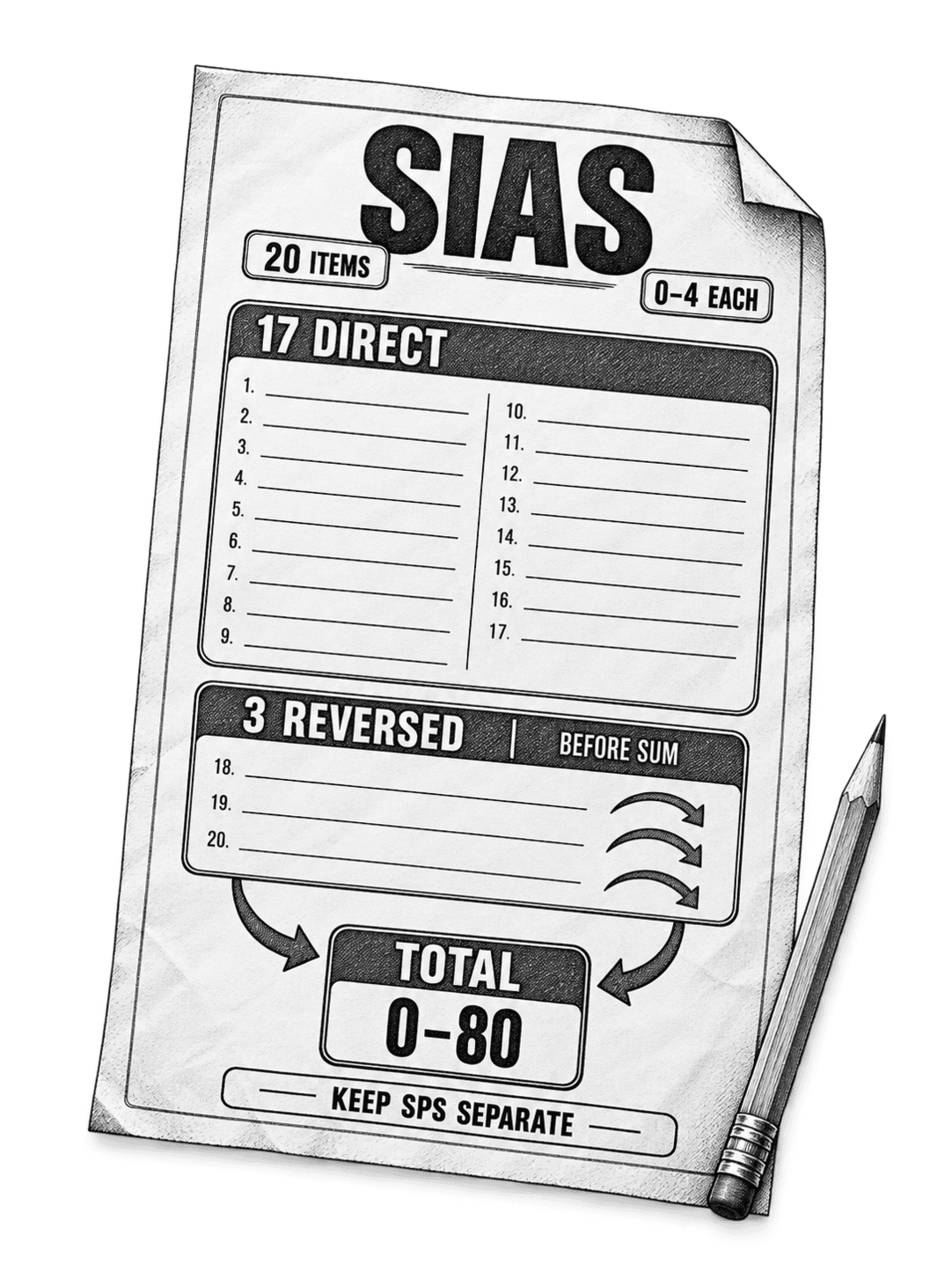
The Social Interaction Anxiety Scale (SIAS) measures anxiety during social interaction. In the commonly used 20-item form, responses score 0 to 4; the values for three positively worded items are reverse scored before all corrected values are added for a 0-to-80 total. Higher totals indicate more interaction anxiety. The SIAS cannot diagnose social anxiety disorder, and no universal severity bands apply.
Which SIAS version this page covers
Richard Mattick and Christopher Clarke developed the SIAS with the Social Phobia Scale. Their 1998 paper treats them as companion measures with different targets.
The SIAS was published as a 19-item form. A 20-item form had already been distributed before publication and became widely used; it includes one additional reverse-worded item and is the scoring contract described on this page.
The 19-item variant, 17-item Straightforward SIAS, SIAS-6, and SIAS10 are separate forms; the 17-item form, for example, runs from 0 to 68. Their totals are not interchangeable.
What it measures and how it is administered
The SIAS focuses on anxiety and discomfort while meeting, talking with, or responding to other people. It does not primarily measure fear of being watched while performing a task, and it does not provide a complete measure of avoidance or functioning.
The commonly used form is an adult self-report measure. No fixed recent recall window applies. Its response choices describe how characteristic each statement is of the respondent.
The reviewed scoring contract has 20 responses and a 0-to-4 scale. A modified timeframe or item set needs its own evidence and should be labeled as a different administration.
How scoring works
The values for three positively worded items are reverse scored, then all 20 corrected values are added. The total ranges from 0 to 80, with higher values indicating more social interaction anxiety.
An independent validation confirms the 20-response structure, three reversals, and 0-to-80 range.
The reviewed sources did not provide a universal replacement or proration rule for missing responses. Missing values are not zero, and an incomplete form is not a standard SIAS total unless a validated protocol specifies the method.
Keep the SIAS and SPS totals separate. A combined 0-to-160 score is not standard scoring unless a research protocol explicitly defines and supports that analysis.
How to interpret a SIAS score
A higher total means that the respondent reports more anxiety or discomfort during social interaction, but the number should be reviewed with the interactions causing difficulty, avoidance, functional impact, and the person's circumstances.
There is no single SIAS cutoff. An Oxford assessment guide suggests 34 or higher for social anxiety disorder and 42 or higher for the historical generalized subtype. A Dutch validation reported different decision points of 23 or higher for men and 27 or higher for women. These values came from different populations and purposes, so they are not universal severity bands or diagnoses.
For repeated measurement, keep the version, language, instructions, and administration method the same. Score change alone does not establish why symptoms changed or whether an individual recovered.
SIAS, SPS, and LSAS answer different questions
The SPS focuses on anxiety about scrutiny and observed performance. The clinician-administered LSAS rates both fear and avoidance across a broader set of social and performance situations.
These measures overlap, but their content, respondents, and scoring ranges differ. Their totals are not interchangeable.
What the result cannot establish
The SIAS cannot confirm or rule out social anxiety disorder, identify the cause of the ratings, or select treatment. A low total can coexist with one severe social fear, and a high total does not provide a complete account of functioning.
Related assessment information
These pages cover related assessments. They may measure different constructs or use different populations and recall periods.
Register interest
Tell us which survey interests you. We will contact you if it becomes available on Survey Doctor.
Contact us