QIDS-SR-16: nine-domain depression symptom score
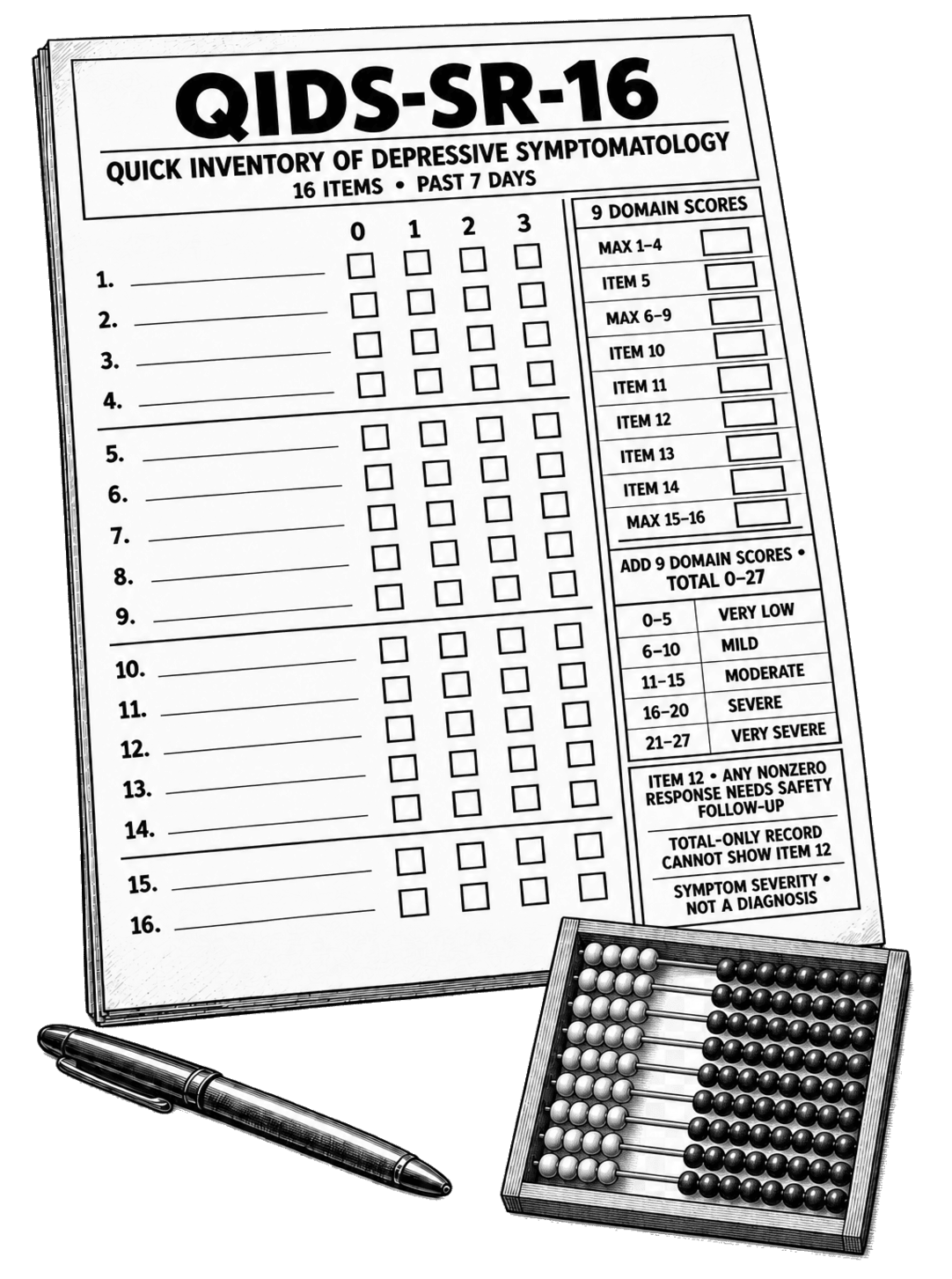
The QIDS-SR-16 turns 14 selected answers across 16 items into nine domain scores and a 0-to-27 depression symptom total.
Overview
The QIDS-SR-16 asks about depressive symptoms mainly over seven days; two weight items use two weeks. Although the form has 16 items, two either-or pairs mean standard completion contains 14 selected answers. Survey Doctor takes the maximum within three grouped domains, then sums nine domain scores for a 0-to-27 total. It does not diagnose depression.
Introduction
The QIDS-SR-16 source form covers the nine depression symptom domains used when it was developed. Several domains can appear in opposite or overlapping ways. Four items cover sleep, four cover appetite and weight change, and two cover slowed movement versus restlessness.
That design avoids counting several expressions of one domain as separate symptoms. Survey Doctor uses the published domain maxima. The underlying answers still matter because the total cannot show which sleep, appetite, weight, or movement pattern produced it.
Who should take this assessment?
The QIDS-SR-16 may be useful when a qualified provider or research protocol calls for this exact depression symptom measure. The originating study concerned adults receiving care for chronic nonpsychotic major depression, so results should not be generalized to every age, diagnosis, or setting without supporting evidence.
Use the exact form. Other QIDS and IDS versions have different item counts or respondents.
Scoring
Each selected answer is rated 0 to 3. The published scoring method uses the highest rating within sleep, appetite/weight, and psychomotor change; the other six domains contribute one item each:
- Sleep disturbance: highest of items 1-4
- Sad mood: item 5
- Appetite/weight change: highest of items 6-9 (complete either 6 or 7, and either 8 or 9)
- Concentration/decision making: item 10
- View of myself: item 11
- Thoughts of death or suicide: item 12
- General interest: item 13
- Energy level: item 14
- Psychomotor change: highest of items 15-16
The total is the sum of the nine domain scores (0-27):
| Score | Severity |
|---|---|
| 0-5 | Very low symptom range |
| 6-10 | Mild depression |
| 11-15 | Moderate depression |
| 16-20 | Severe depression |
| 21-27 | Very severe depression |
The source convention often labels 0-5 as "none." That is a symptom-range label, not proof that depression or another condition is absent.
The PHQ-9 is a different questionnaire with a plain nine-item sum. Do not convert between PHQ-9 and QIDS-SR-16 totals.
A response above zero to item 12, which asks about thoughts of death or suicide, needs attention regardless of the total score. Survey Doctor can evaluate this only when the person completes the native item form. A manually entered total or an imported score summary does not contain the item 12 answer.
If you need help now. In the US, Call 988 or text 988. Call 911 if you are in immediate danger. Outside the US, contact your local emergency number or find support in your country.
For a plain-language walkthrough of what each band means and what to do next, see what your QIDS-SR-16 score means.
Interpreting your results
The QIDS-SR-16 measures symptom severity; it does not by itself diagnose depression or select treatment. The bands provide a shared vocabulary for discussing the total. They are not instructions to start, stop, or change care.
If you repeat the questionnaire, use the same administration and discuss the interval with your clinician. Compare QIDS totals only with other correctly scored QIDS-SR-16 totals.
Comparing older records
Native Survey Doctor QIDS-SR-16 results use the official 0-to-27 domain-max method. Older imported summaries may reflect a plain item sum with different completion rules. Survey Doctor shows those saved numbers in reports and trend charts without current bands, because the formula behind them is unverified.
Do not re-label an older summary as an official QIDS-SR-16 total unless its item-level scoring can be verified. A number alone cannot prove the formula.
Evidence boundary
The 2003 psychometric study evaluated the self-report form in 596 adult outpatients with chronic nonpsychotic major depression. Later STAR*D work supports the nine-domain maximum method and 0-to-27 range used here.
That evidence supports symptom-severity measurement in defined clinical samples. It does not make the score a standalone diagnosis or establish one repeat schedule for every use.
Related assessment information
These pages cover related assessments. They may measure different constructs or use different populations and recall periods.
Ready to get started?
Take the QIDS-SR-16: nine-domain depression symptom score and gain valuable insights into your mental health
Start assessment