GDS-30: Geriatric Depression Scale, 30-item version
What the original 30-item Geriatric Depression Scale measures, how its 0-to-30 score works, and why the result is not a diagnosis.
What this assessment is
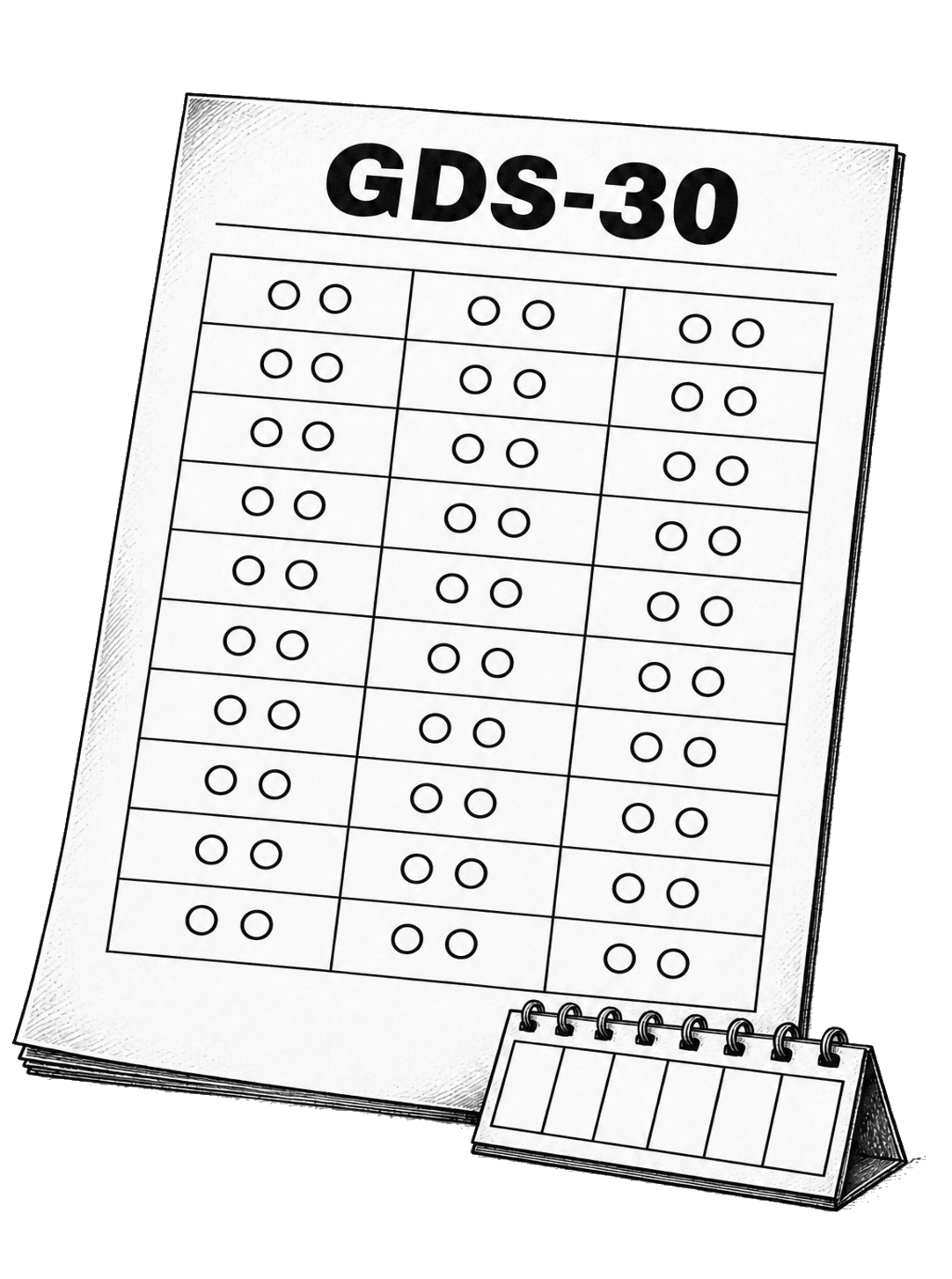
The GDS-30 is the original 30-item long form of the Geriatric Depression Scale, asking older adults about the past week with yes-or-no responses and producing a total from 0 to 30. Its original score bands are screening labels. They do not diagnose depression.
Jerome Yesavage and colleagues developed the scale for later-life assessment. The original study selected the questions that most closely tracked the full item pool, then tested the resulting form in older adults classified with research diagnostic criteria.
The GDS-15 is a separate short form drawn from the original scale. Its score range and bands are different.
Who it was designed for
The scale was designed for older adults. Its yes-or-no response format is simple, but the 30-item form can still be difficult for some people to complete.
The person must be able to understand the questions and answer reliably. Studies have reported different performance in people with mild cognitive impairment or Alzheimer disease and in nursing-home residents with cognitive impairment. No single cognitive threshold fits every setting.
Hearing, vision, language, physical illness, grief, medication, and living circumstances can also affect the assessment context.
How it is administered
The standard long form asks how the person has felt over the past week. It uses 30 yes-or-no questions.
Some protocols read the exact questions aloud, but written and oral results are not necessarily interchangeable; one administration-mode study found poorer agreement among participants with cognitive impairment.
Use a supported protocol and keep the wording, timeframe, and administration mode consistent. Do not combine long-form and short-form questions or compare their raw totals directly.
What it measures
The GDS-30 covers mood, interest, energy, hope, memory concerns, social engagement, and related experiences, while its development reduced somatic symptom content compared with many general depression measures.
That design reduces one source of overlap with physical illness, but it does not remove medical or cognitive explanations. The result is not a complete review of physical or cognitive health.
How scoring works
Each response is scored 0 or 1, with one point assigned when the response follows the depression-keyed direction.
The 30 values are added. The total runs from 0 to 30, with higher scores indicating more reported depressive symptoms.
The developer's long-form scoring page provides the response key and original bands.
No verified universal GDS-30 missing-response rule was found, and the developer's advisory example for the 15-item form should not be transferred to the long form. Do not invent values for unanswered questions.
How to interpret a GDS-30 score
The original long-form bands are:
- 0 to 9: original normal-range label
- 10 to 19: original mild-range label
- 20 to 30: original severe-range label
These are screening labels, not diagnoses. The word normal comes from the original scoring language. It does not prove that depression is absent.
A 2023 USPSTF evidence review found that GDS-30 studies used varied thresholds and did not provide enough consistent evidence for one cutoff-performance relationship. A score near a boundary should not be treated as categorically different from a score just across it.
Symptoms, daily function, change from the person's usual state, and clinical history still matter.
Safety is separate from the total
The GDS-30 does not directly assess suicide or self-harm. A low total cannot replace a direct safety assessment when a person may be at risk.
If you need help now. In the US, Call 988 or text 988. Call 911 if you are in immediate danger. Outside the US, contact your local emergency number or find support in your country.
What the score cannot tell you
The GDS-30 cannot confirm or rule out a depressive disorder or explain whether symptoms relate to bereavement, illness, medication, cognitive change, isolation, or another cause.
It also cannot select treatment or establish urgency by itself. A clinician should review concerning symptoms and changes in functioning directly, regardless of the total.
Evidence and limitations
The development study found that GDS scores tracked research diagnostic criteria in the studied older adults. The American Psychological Association's GDS overview describes the long and short forms as later-life depression screens.
Those findings do not make one boundary suitable for every population. Language, culture, cognitive status, administration mode, care setting, and physical health can affect performance.
Use a validated translation when needed. Keep the version and administration method consistent when tracking change.
Related assessment information
These pages cover related assessments. They may measure different constructs or use different populations and recall periods.
Register interest
Tell us which survey interests you. We will contact you if it becomes available on Survey Doctor.
Contact us