AUDIT-C: three-item alcohol screen
What AUDIT-C measures, how its 0-to-12 total works, and why a positive cutoff depends on the exact form and screening policy.
What this assessment is
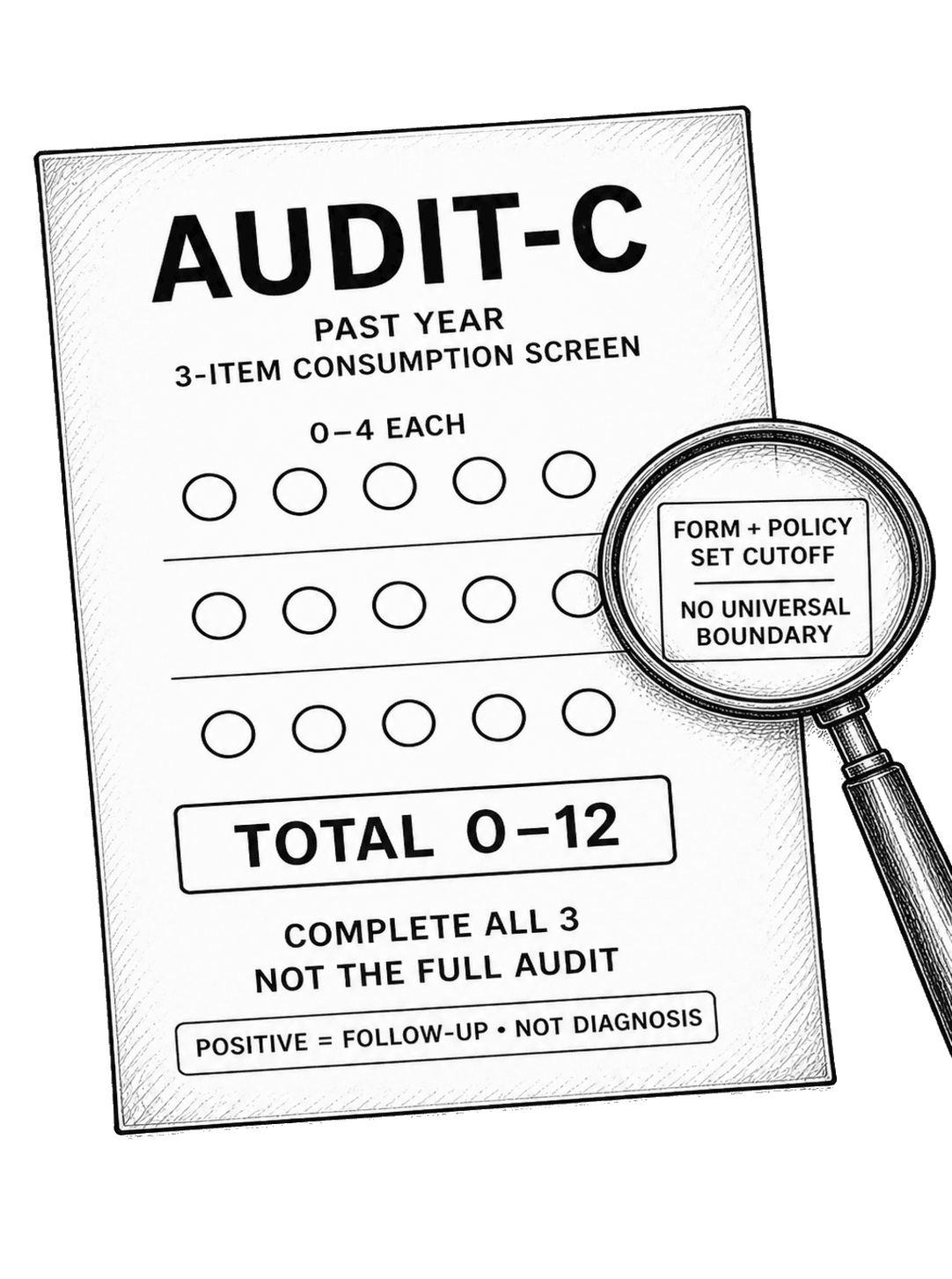
AUDIT-C is a three-item, past-year alcohol-consumption screen with a total from 0 to 12. A positive cutoff depends on the exact form and screening policy. Common boundaries include 4 or higher for men and 3 or higher for women, or 5 or higher for everyone in current VA practice.
Kristen Bush and colleagues tested the brief form in a 1998 validation study of men receiving care in Veterans Affairs clinics, using the consumption questions from the full 10-item AUDIT.
AUDIT-C is not the full AUDIT and does not directly assess dependence-related experiences or alcohol-related harm.
An AUDIT-C result does not diagnose an alcohol use disorder.
Who it was designed for
The original study involved men receiving care in three U.S. Veterans Affairs clinics. Later studies expanded the evidence to women, general primary care, and other settings.
This development history limits generalization. A cutoff that worked in one sample may not give the same balance of missed cases and false positives elsewhere.
Use a threshold validated for the exact form, population, and purpose whenever possible.
How it is administered
AUDIT-C asks about alcohol use during the past year. It can be self-completed or asked as part of a clinical interview.
More than one current form exists: the original third question uses one high-quantity drinking threshold, while the current U.S. Department of Veterans Affairs form changes that threshold according to sex and age.
That difference is substantive, so a report should identify which wording and policy were used. Scores from different forms should not be treated as interchangeable without review.
What it measures
AUDIT-C covers three parts of alcohol consumption:
- how often a person drinks
- the usual amount consumed on a drinking day
- how often higher-quantity drinking occurs
It does not cover the full AUDIT's dependence-related experiences or alcohol-related harm.
A brief result can start a conversation, but it cannot describe the whole pattern.
How scoring works
Each response scores from 0 to 4, and the three values are added for a total from 0 to 12.
Higher scores indicate a greater likelihood of risky alcohol use. There are no severity bands that work across every AUDIT-C form and population.
Complete all three questions when possible. Do not replace a missing answer with zero unless a defined protocol supports that choice.
How to interpret an AUDIT-C score
Interpretation starts with the form, population, and policy.
| Source and population | Positive-screen boundary |
|---|---|
| Original 1998 validation in men at three VA clinics | 3 or higher |
| 2007 adult primary care validation | 4 or higher for men; 3 or higher for women |
| AHRQ-hosted clinical form | 5 or higher for men; 3 or higher for women |
| Current VA modified form and VA/DoD policy | 5 or higher for everyone |
None of these boundaries is universal. A service should choose its form and threshold before screening, document both, and keep them stable when comparing results over time.
A positive result means that further assessment is appropriate. It does not establish an alcohol use disorder.
What the score cannot tell you
AUDIT-C cannot show whether alcohol has caused injury, withdrawal, loss of control, relationship problems, or difficulty meeting responsibilities.
It cannot determine whether stopping suddenly could be dangerous. NIAAA advises people who have been drinking heavily for a prolonged period to seek medical help before stopping suddenly. ASAM also identifies a history of severe or complicated withdrawal as a risk factor for future complications. Severe withdrawal symptoms need urgent medical care.
Follow-up should review drinking quantity and pattern, dependence-related features, harm, physical and mental health, medications, pregnancy, and the person's priorities.
Evidence and limitations
In the original VA study, AUDIT-C performed well as a brief screen for heavy drinking or active alcohol problems, but the sample excluded women and limits how directly those findings apply to other groups.
A primary care validation study found useful performance in men and women but supported different thresholds by sex. Other healthcare systems have chosen different policies to fit their population and workflow.
Its brevity is also its main limit: three consumption questions leave out important information that the full AUDIT and a clinical assessment can provide.
Related assessment information
These pages cover related assessments. They may measure different constructs or use different populations and recall periods.
Register interest
Tell us which survey interests you. We will contact you if it becomes available on Survey Doctor.
Contact us