AUDIT: Alcohol Use Disorders Identification Test
What the 10-item AUDIT measures, how its 0-to-40 score works, and why WHO risk zones guide follow-up rather than diagnose an alcohol use disorder.
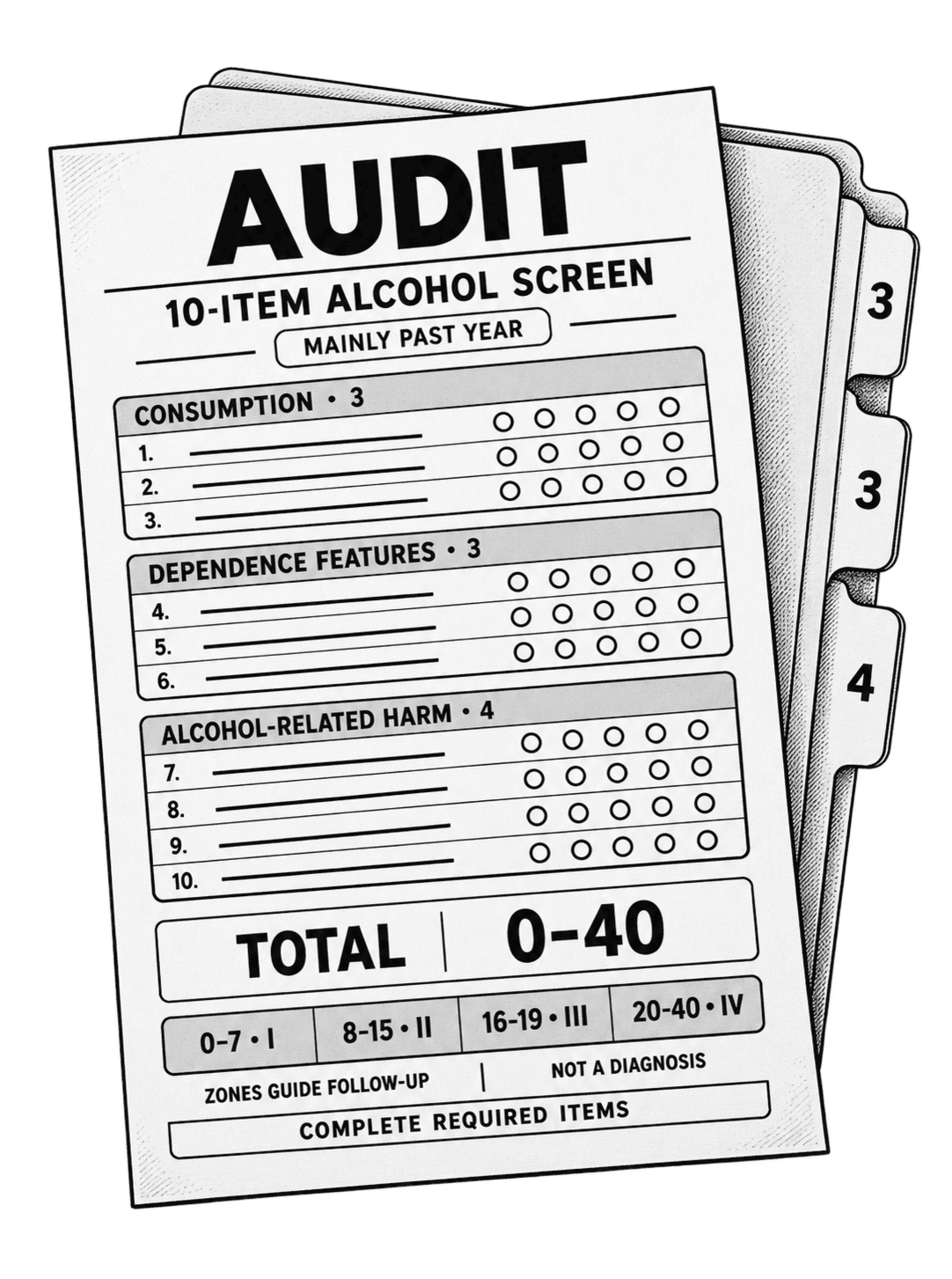
What this assessment is
The 10-item AUDIT mainly covers the past year, while its final two items can also record earlier lifetime events. It produces a total from 0 to 40. The WHO manual uses 8 or higher as its usual screening threshold and recommends further diagnostic evaluation at 20 or higher. Neither boundary is a diagnosis.
The World Health Organization developed the Alcohol Use Disorders Identification Test through a six-country primary care study, and the original development paper describes how the questions and total score were selected and tested.
The AUDIT-C is a shorter three-item form that covers alcohol consumption only. It does not include the AUDIT questions about dependence-related experiences or harm.
Who it was designed for
The original evidence came from primary care patients in six countries. This page focuses on adults because the reviewed guidance and cutoffs address adult screening.
The AUDIT is now used in healthcare, public health, and research. Each setting still needs a clear plan for what happens after a positive result.
Evidence from one population does not automatically transfer to another. Age, sex, culture, local drinking patterns, medical conditions, and the reason for screening can affect how a result should be read.
How it is administered
The standard AUDIT mainly asks about the past year, but its final two items distinguish events in the last year from those that happened only earlier. The form can be self-completed or asked by an interviewer.
The WHO manual recommends a friendly, nonthreatening approach and an assurance of confidentiality. These conditions support more candid reporting.
Use the 10-item AUDIT rather than an abbreviated form when reporting the standard total. Keep the version fixed. Translations, adaptations, shortened forms, and changed timeframes can affect comparability and need evidence appropriate to that version and setting.
What it measures
The AUDIT covers three connected areas:
- alcohol consumption in the first three questions
- experiences associated with possible dependence in the next three
- alcohol-related harm in the final four
The total combines all three areas. Two people can have the same total for different reasons, so the response pattern can be more informative than the number alone.
How scoring works
Under the WHO scoring method, most responses score from 0 to 4. Responses to the final two items use 0, 2, or 4 points. Adding the 10 values produces a total from 0 to 40.
Higher scores indicate greater likelihood of risky use, dependence-related features, or harm.
Do not score an accidentally missing required response as zero. Some authorized interview or computer protocols use skip logic, so distinguish a planned skip from missing data and follow the exact protocol in use. The WHO manual does not establish one replacement rule for every setting.
How to interpret an AUDIT score
The 2001 WHO manual uses four broad zones:
| Total | WHO zone | How to read it |
|---|---|---|
| 0 to 7 | Zone I | Lowest zone in the manual; it does not guarantee that alcohol use is safe for every person. |
| 8 to 15 | Zone II | Above the manual's usual screening threshold. |
| 16 to 19 | Zone III | Higher zone that supports more detailed follow-up. |
| 20 to 40 | Zone IV | The manual recommends further diagnostic evaluation for possible alcohol dependence. |
A total of 8 or higher is the manual's usual starting point for identifying hazardous or harmful alcohol use and possible dependence. A score of 20 or higher supports further diagnostic evaluation for possible alcohol dependence.
These boundaries are not universal. The 2001 manual notes that a cutoff of 7 can improve sensitivity for women and men over 65, while a cutoff of 10 can improve specificity. Services also need to consider population evidence and local drinking standards.
Do not switch boundaries after seeing the result.
The zones guide the intensity of follow-up. They do not prescribe treatment, prove dependence, or mean that a person below 8 has no alcohol-related risk. “Alcohol dependence” is the terminology used in the 2001 manual; current diagnostic language may differ.
What the score cannot tell you
The AUDIT cannot confirm a diagnosis, measure every consequence of alcohol use, or determine whether withdrawal could be medically dangerous.
NIAAA advises people who have been drinking heavily for a prolonged period to seek medical help before stopping suddenly. ASAM also identifies a history of severe or complicated withdrawal as a risk factor for future complications. Severe withdrawal symptoms need urgent medical care.
It cannot explain a high score by itself. A proper assessment also reviews the pattern and amount of drinking, medications, physical health, mental health, pregnancy, withdrawal history, daily function, and the person's goals.
A low total does not make every drinking pattern safe. Risk can be substantial at lower amounts for some medical conditions, medicines, activities, and stages of life.
Evidence and limitations
The original six-country study found that the AUDIT could identify hazardous and harmful alcohol use across varied primary care settings, giving the instrument a broad development base.
The score still depends on honest recall and on the exact form used. It can miss risk when drinking is underreported, when the recall structure hides a recent change, or when a local pattern does not fit the validation sample.
The WHO manual calls its intervention zones tentative. Read the result with the person's circumstances and a defined follow-up process.
Related assessment information
These pages cover related assessments. They may measure different constructs or use different populations and recall periods.
Register interest
Tell us which survey interests you. We will contact you if it becomes available on Survey Doctor.
Contact us