Zung SDS: Self-Rating Depression Scale
What the 20-item Zung SDS measures, how raw and index scores differ, and why its reporting bands are not a diagnosis.
What this assessment is
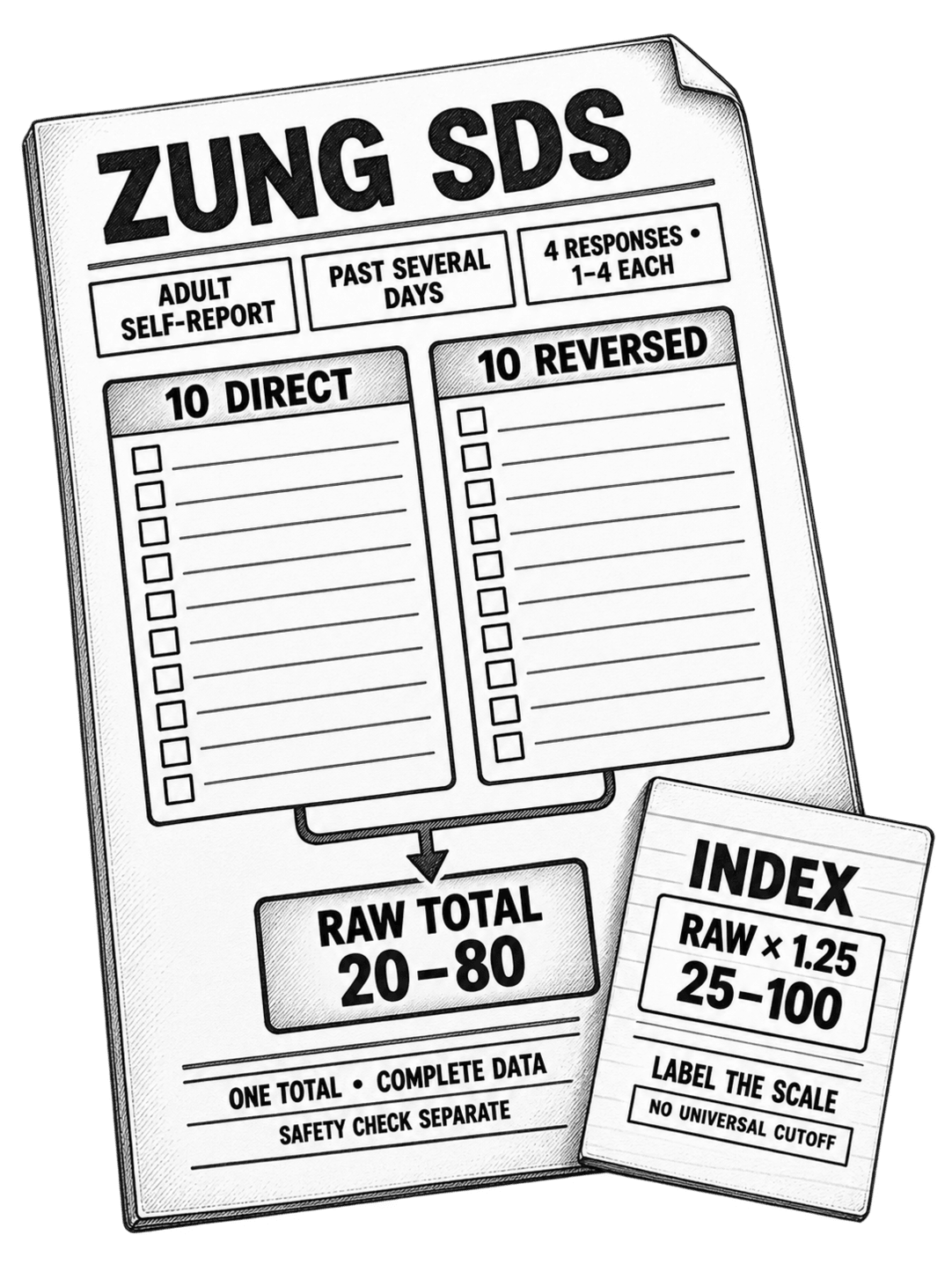
The 20-item Zung SDS rates depressive symptoms over the past several days. It produces a raw score from 20 to 80 and an index from 25 to 100, calculated as the raw score multiplied by 1.25. Higher scores reflect more symptoms. A traditional index threshold of 50 is not a universal diagnostic cutoff.
William W. K. Zung introduced the scale in 1965 to rate depression symptoms and their severity. The total summarizes reported symptoms; it does not diagnose depression.
Who it was designed for
The SDS was developed as an adult self-report measure, and later studies have used it in treated and community samples where the preferred cutoffs have varied by population.
The scale predates current diagnostic systems and many newer depression measures. Interpret a result with evidence from the relevant population rather than treating one cutoff as universal.
How it is administered
The SDS is completed by the respondent. The standard form asks about experiences over the past several days and uses four response levels for each of 20 items.
Ten items are phrased in one scoring direction and ten in the opposite direction. This balance is part of the standard form. A translated, shortened, or altered version may not produce a comparable score.
The AHRQ instrument summary describes the standard self-administered format and its four broad symptom areas.
What it measures
The SDS combines several kinds of depressive symptoms into one total. The AHRQ summary groups them into pervasive emotional effects, physical equivalents, other disturbances, and psychomotor activity.
One total can support screening or tracking, but it cannot show which symptom group drove the result, explain the cause, or establish whether a depressive disorder is present.
How scoring works
Each response contributes 1 to 4 points. Ten items are reverse scored before all 20 values are added.
This produces a raw score from 20 to 80. The raw total can then be converted to an index from 25 to 100 by multiplying it by 1.25.
The two systems are easy to confuse. An index score of 50 equals a raw score of 40. A scoring review found that studies have sometimes applied the index cutoff to the raw total by mistake.
Raw and index are not interchangeable. Always label which result is being reported.
Multiplying by 1.25 can produce quarter-point index values. The sources reviewed for this page do not establish one universal rounding rule, so any rounding method should be stated.
The sources reviewed for this page do not establish one universal rule for missing responses. Complete data are preferable. If a study or service uses a missing-item method, it should state that method with the result.
How to interpret a Zung SDS score
A common reporting convention uses the 25-to-100 index:
- 25 to 49: below the traditional index threshold
- 50 to 59: mild range
- 60 to 69: moderate range
- 70 to 100: severe range
These are descriptive index bands reported in the AHRQ scale summary. They are not raw-score bands, and they do not confirm a depressive disorder.
The boundary is not universal. A later Australian study found the traditional raw-score threshold too low in its clinical and community samples. That result does not establish one replacement cutoff for every population.
Use the scoring convention and cutoff validated for the population and purpose. Do not switch between raw and index values or treat one boundary as suitable for every setting.
A score does not replace a safety check
The SDS includes a death-related item. A total score must never override concern about that response or a person's immediate safety.
If you need help now. In the US, Call 988 or text 988. Call 911 if you are in immediate danger. Outside the US, contact your local emergency number or find support in your country.
Any concerning response needs direct, timely follow-up. A low total does not make it less important.
What the score cannot tell you
The SDS cannot diagnose depression, determine its cause, or distinguish a depressive disorder from grief, physical illness, medication effects, sleep problems, or another mental health condition.
It also cannot select a treatment. Diagnosis and care decisions require a clinical assessment that considers symptoms, functioning, history, safety, and the person's priorities.
Evidence and limitations
The 1965 development paper established the scale. Later studies have reported different preferred cutoffs across populations.
That disagreement shows why a score needs its version, scoring system, population, and purpose attached. The SDS can support screening and symptom tracking. It cannot carry the full weight of a diagnostic decision.
Register interest
Tell us which survey interests you. We will contact you if it becomes available on Survey Doctor.
Contact us