Y-BOCS: Yale-Brown Obsessive Compulsive Scale
A clinician-rated scale designed to measure the severity and type of symptoms in patients with obsessive-compulsive disorder (OCD).
About the survey
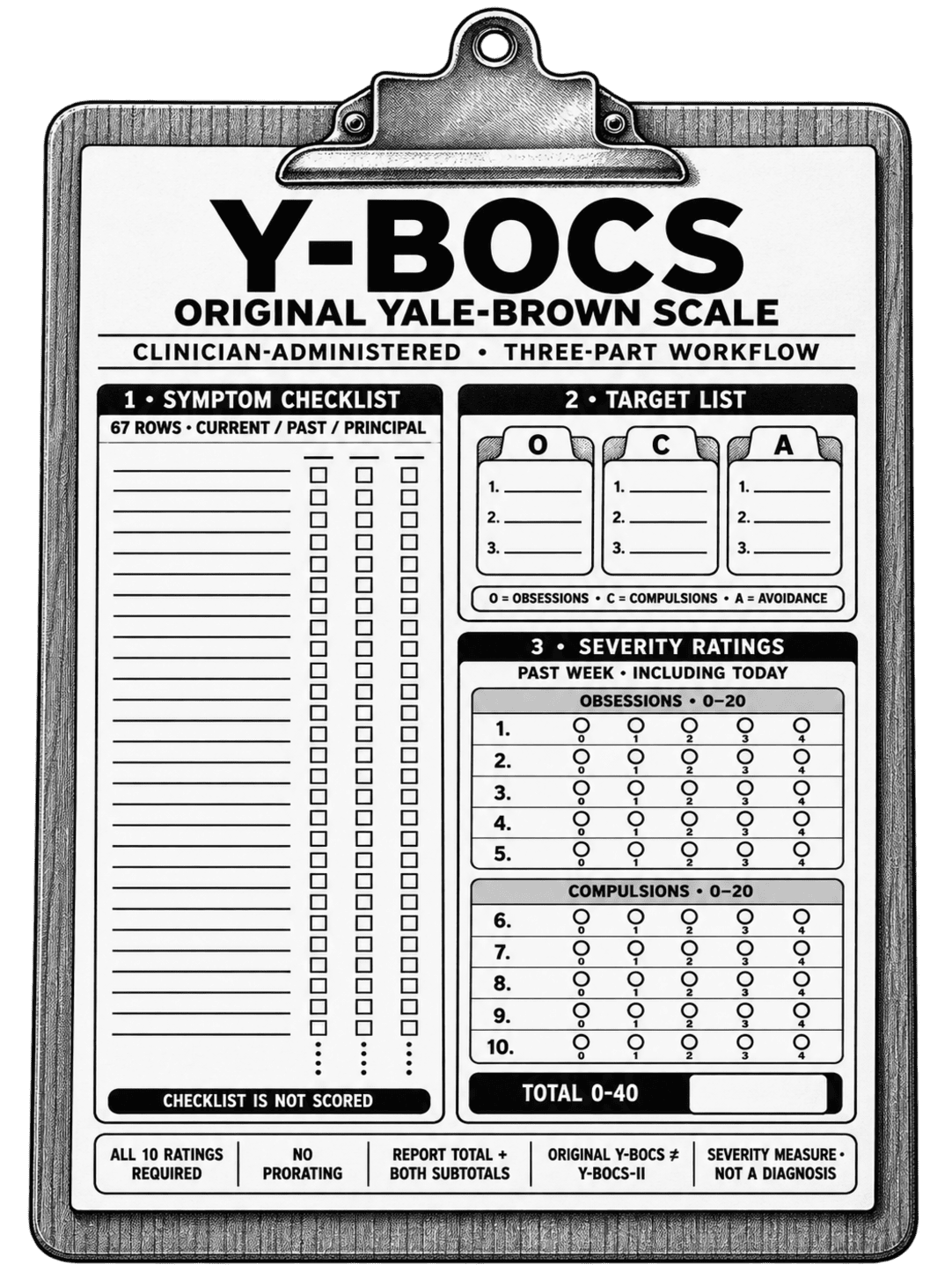
The Yale-Brown Obsessive Compulsive Scale (Y-BOCS) measures the severity of obsessive-compulsive symptoms. A trained clinician administers it as an interview. It is not a self-report screen or a diagnostic test. Goodman and colleagues developed the Y-BOCS.
A full administration has three parts: a symptom checklist, a list of target symptoms for obsessions, compulsions, and avoidance, and ten severity ratings. The checklist records whether each symptom is current or past, and it is not scored. At follow-up, the clinician can review the target symptoms and repeat the ten severity ratings.
Scoring and interpretation
Each severity item scores from 0 to 4, so the ten ratings produce a total from 0 to 40. The first five ratings form the obsessions subtotal and the last five form the compulsions subtotal, each from 0 to 20. The severity ratings cover the past week, including today.
The clinician interprets the total, both subtotals, the target symptoms, and change over time. A Y-BOCS score measures symptom burden after the clinical picture has been established. It does not diagnose OCD or explain why symptoms occur.
Considerations
The Original Y-BOCS and the Y-BOCS-II are different instruments. The Y-BOCS-II has different items and scoring, so its scores cannot be compared with or converted to Original Y-BOCS scores.
Compare results only when the same edition, scoring rules, and administration method were used.
Limitations
The score does not establish a diagnosis. It also does not replace a broader assessment of function, insight, risk, related conditions, or the meaning of a reported symptom.
Checklist completion depends on disclosure and clinician judgment. A person may not report every unwanted thought or ritual during one interview.
Related assessment information
These pages cover related assessments. They may measure different constructs or use different populations and recall periods.
Explore the assessment library
Read clear guides to assessment scoring, administration, and interpretation.
Browse assessments