PSS-10: Perceived Stress Scale, 10-item version
What the PSS-10 measures, how its total is calculated, and why the score has no universal clinical bands.
What this assessment is
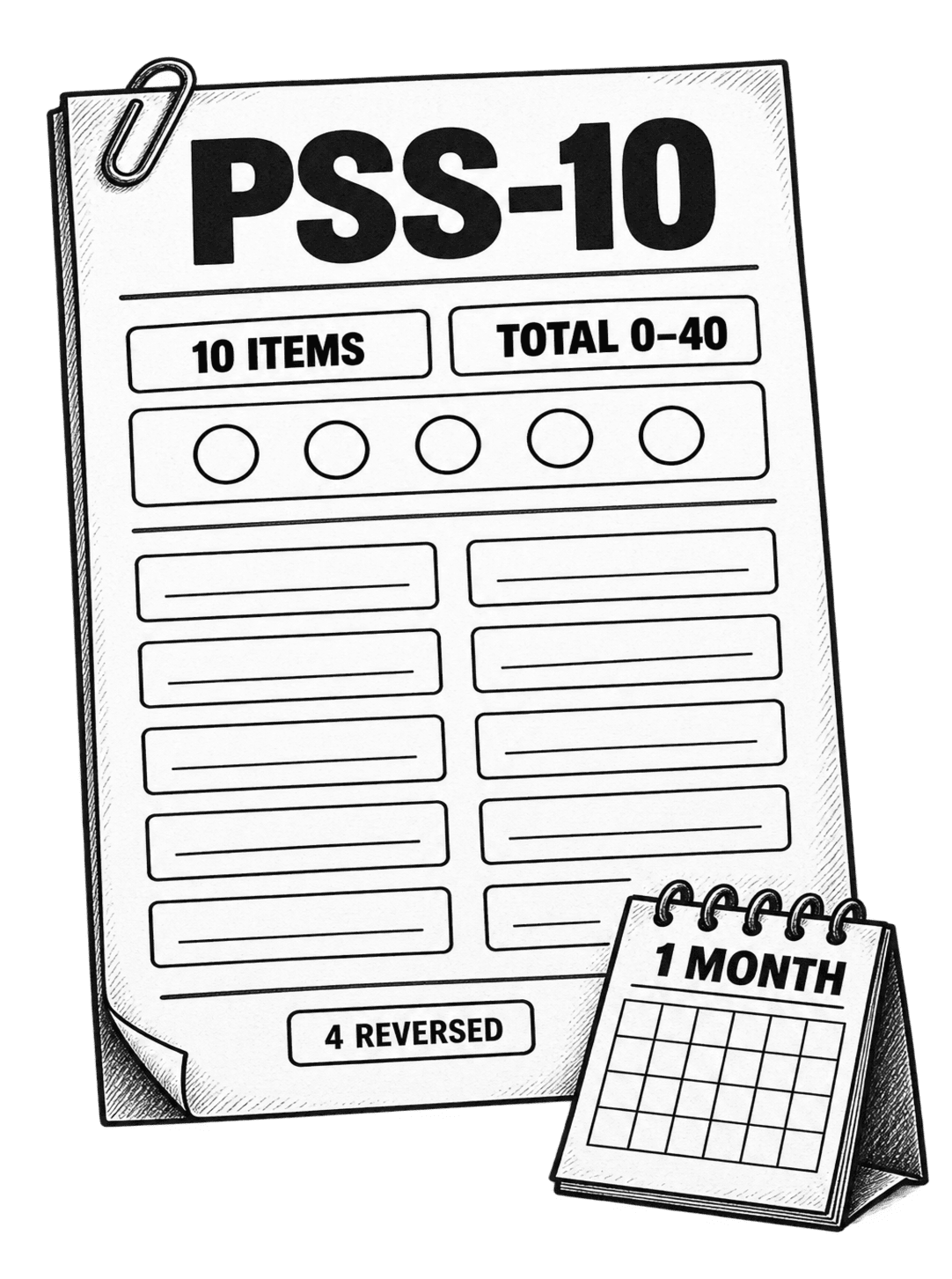
The PSS-10 measures perceived stress over the past month. Its total runs from 0 to 40, with higher scores reflecting greater perceived stress. The questionnaire has no universal clinical cutoff and does not diagnose a condition. It records how unpredictable, uncontrollable, or overloaded life has felt.
The scale measures a person's appraisal of stress, not the number of difficult events that occurred. People facing similar demands can therefore receive different scores.
Cohen and Williamson established the 10-item form in 1988. They derived it from the earlier Perceived Stress Scale developed by Sheldon Cohen, Tom Kamarck, and Robin Mermelstein. The original PSS study distinguished perceived stress from simply counting difficult events.
Who it was designed for
The PSS was designed as a general measure rather than a screen for one disorder or source of stress, and researchers have since used the PSS-10 in community, education, workplace, and healthcare settings.
A translation needs evidence for its intended population. A score from one setting should not automatically be compared with a norm from another because age, language, setting, and the timing of data collection can affect the comparison.
How it is administered
The author's PSS-10 form is completed by the respondent. It asks about the previous month and uses a five-point frequency scale.
The Cohen laboratory guidance says the laboratory has not published psychometric evidence for other recall periods. If the timeframe changes, report it rather than treating the result as the standard month-based version.
What it measures
The scale covers a broad appraisal of stress. Its questions address experiences such as limited control, unpredictability, overload, and confidence in coping.
It cannot identify the cause. A total cannot separate work stress from caregiving, illness, financial strain, relationships, or another cause. That usually requires a conversation or a more specific measure.
How scoring works
The author's scoring instructions assign 0 to 4 points to each response. Four positively worded responses are reversed before all 10 values are added, producing a total from 0 to 40.
The reversal keeps the direction consistent. A response that reflects stronger perceived coping lowers the final stress total rather than raising it.
How to interpret a PSS-10 score
The instrument author's guidance says the PSS-10 is not diagnostic and has no universal score cutoff. It recommends comparisons within a study sample or against suitable normative data.
Common labels such as “low,” “moderate,” and “high” should not be treated as official clinical bands. The same version can describe how a person's score changes over time, but there is no universal point change that proves meaningful improvement. Repeated scores still need context.
Context is part of the interpretation. A useful comparison names the population, language, survey version, and time period behind the reference data.
What the score cannot tell you
The PSS-10 is not diagnostic. It cannot determine whether someone has an anxiety disorder, depression, burnout, or another condition, explain why stress feels high, or select a treatment.
A low total does not rule out a problem that matters. A high total can support a closer look at current pressures and coping, but it should not replace a clinical assessment when someone is concerned about their health.
Evidence and limitations
An independent psychometric review found generally stronger evidence for the PSS-10 than for the 14- and 4-item forms, while noting gaps in test-retest and criterion validity.
The measure's breadth is useful, but it is also a limit. One total cannot identify the source, duration, or practical consequences of stress. The same review found inconsistent evidence about the PSS-10's factor structure, so researchers should not assume that every population produces the same pattern.
Register interest
Tell us which survey interests you. We will contact you if it becomes available on Survey Doctor.
Contact us