PHQ-SADS: Somatic, anxiety, and depression scales
How PHQ-SADS combines three scored symptom scales with panic and difficulty questions, and why its component totals stay separate.
What this assessment is
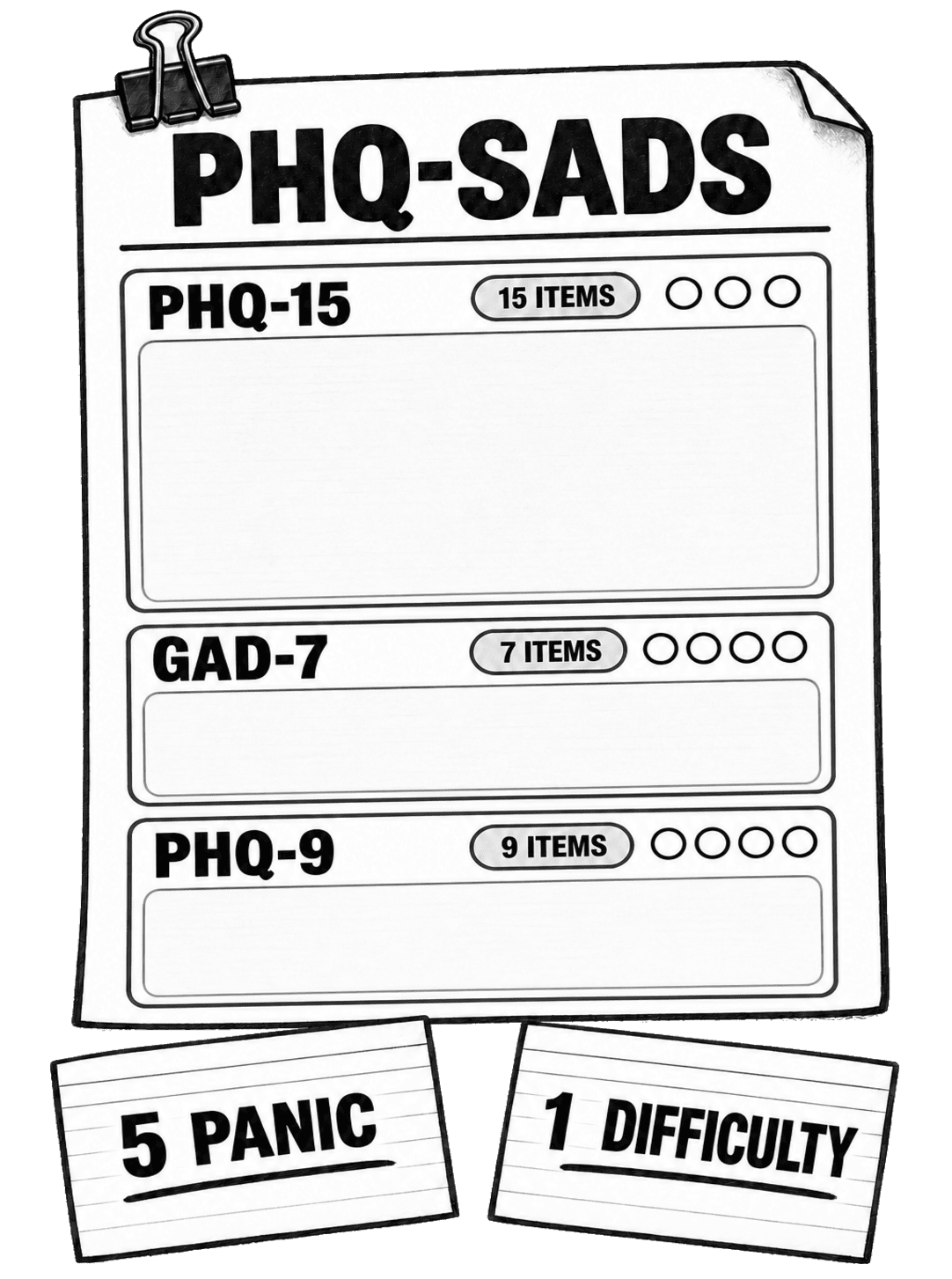
The full 2010 PHQ-SADS contains 37 response prompts: three established symptom scales, five panic questions, and one global difficulty item. It reports three component totals. The defining review does not provide a formula for combining them into one grand total.
The name stands for Patient Health Questionnaire Somatic, Anxiety, and Depressive Symptom Scales, which describes the three symptom areas covered by the assessment.
The panic responses and difficulty item also remain outside the three totals. A form that omits them is a modified or abbreviated version of the full Appendix A form.
Who it was designed for
The PHQ scales were developed for adults in primary care and other medical settings, where physical symptoms, anxiety, and depression may overlap.
It supports screening and symptom measurement. It does not replace a medical review or mental health assessment.
Evidence from one age group, language, or setting should not be assumed to apply everywhere. Modified forms need their own validation.
How it is administered
The PHQ-15 asks about physical symptoms during the past four weeks, while the GAD-7 and PHQ-9 ask about the past two weeks.
The response scales also differ. PHQ-15 responses contribute 0 to 2 points. GAD-7 and PHQ-9 responses contribute 0 to 3 points.
The first panic question uses a four-week anchor. Later panic questions address attack history and features rather than adding another continuous symptom total. The global difficulty response is also reviewed separately.
What it measures
PHQ-SADS gives three continuous symptom scores:
- PHQ-15 records physical symptom burden.
- GAD-7 records generalized anxiety symptoms.
- PHQ-9 records depressive symptoms.
The panic responses describe a different part of the clinical picture, and the global item records symptom-related difficulty.
Some experiences, including sleep and energy problems, appear in both PHQ-15 and PHQ-9 contexts. Score each component as published rather than manually removing overlap.
The pattern can guide follow-up questions. It cannot establish the cause.
How scoring works
Score each component with its own rules:
- PHQ-15: add 15 responses for a total from 0 to 30.
- GAD-7: add seven responses for a total from 0 to 21.
- PHQ-9: add nine responses for a total from 0 to 27.
Do not add these three totals together.
The systematic review describes these common bands:
| Component | Total range | Common symptom bands |
|---|---|---|
| PHQ-15 | 0 to 30 | 0 to 4 minimal, 5 to 9 mild, 10 to 14 moderate, 15 to 30 severe |
| GAD-7 | 0 to 21 | 0 to 4 minimal, 5 to 9 mild, 10 to 14 moderate, 15 to 21 severe |
| PHQ-9 | 0 to 27 | 0 to 4 minimal, 5 to 9 mild, 10 to 14 moderate, 15 to 19 moderately severe, 20 to 27 severe |
These are symptom descriptions, not diagnoses or treatment rules. The review warns against using cutoffs inflexibly.
The review describes more than one missing-response method. It recommends asking about blanks when responses can be reviewed directly. For mailed or automated forms, it describes scoring blanks as zero as a conservative option; some research used mean replacement when fewer than 20% of a component's responses were missing. Report the method used, and do not compare results calculated under different rules as if they were identical.
How to interpret PHQ-SADS results
Read the three numbers as a profile.
Review the panic and global difficulty responses separately. They can add context but do not change the three component totals.
A high PHQ-15 result can support a broader review of physical symptoms, but it cannot decide whether those symptoms have a medical, psychological, or mixed cause.
A high GAD-7 or PHQ-9 result shows greater symptom burden. It does not confirm an anxiety or depressive disorder.
The 2010 review found that evidence for sensitivity to change was strongest for the PHQ-9. Evidence for the GAD-7 and PHQ-15 was promising but less established at that time.
Do not confuse PHQ-SADS with PHQ-ADS, which combines PHQ-9 and GAD-7 into one score, or with the newer PHQ-SAD, a different 25-item composite. Those totals are not PHQ-SADS totals.
A score does not replace a safety check
The PHQ-9 component includes a question about death or self-harm. Any endorsement needs direct review, even when the PHQ-9 total is low.
If you need help now. In the US, Call 988 or text 988. Call 911 if you are in immediate danger. Outside the US, contact your local emergency number or find support in your country.
Do not use the PHQ-SADS profile as a substitute for a direct safety assessment or the applicable local emergency protocol.
What the scores cannot tell you
PHQ-SADS cannot diagnose a mental or physical condition. It cannot show which condition caused an overlapping symptom.
The scores cannot choose treatment or determine urgency by themselves. A proper assessment also considers function, history, medication, physical health, recent events, and the person's priorities.
Low results do not rule out a condition. High results do not prove one.
Evidence and limitations
The 2010 systematic review combined evidence from 9,740 patients in four multisite studies with other published research. It found useful measurement properties for all three components.
The components have different purposes and validation histories. Their performance changes with population, language, setting, and cutoff choice.
Report the version, language, timeframes, three separate totals, and any missing-data rule. That information is necessary for a result to be interpreted correctly.
Related assessment information
These pages cover related assessments. They may measure different constructs or use different populations and recall periods.
Register interest
Tell us which survey interests you. We will contact you if it becomes available on Survey Doctor.
Contact us