CAGE-AID: CAGE Adapted to Include Drugs
What the four-item CAGE-AID screens for, how its 0-to-4 score works, and why one-point and two-point decision rules serve different purposes.
What this assessment is
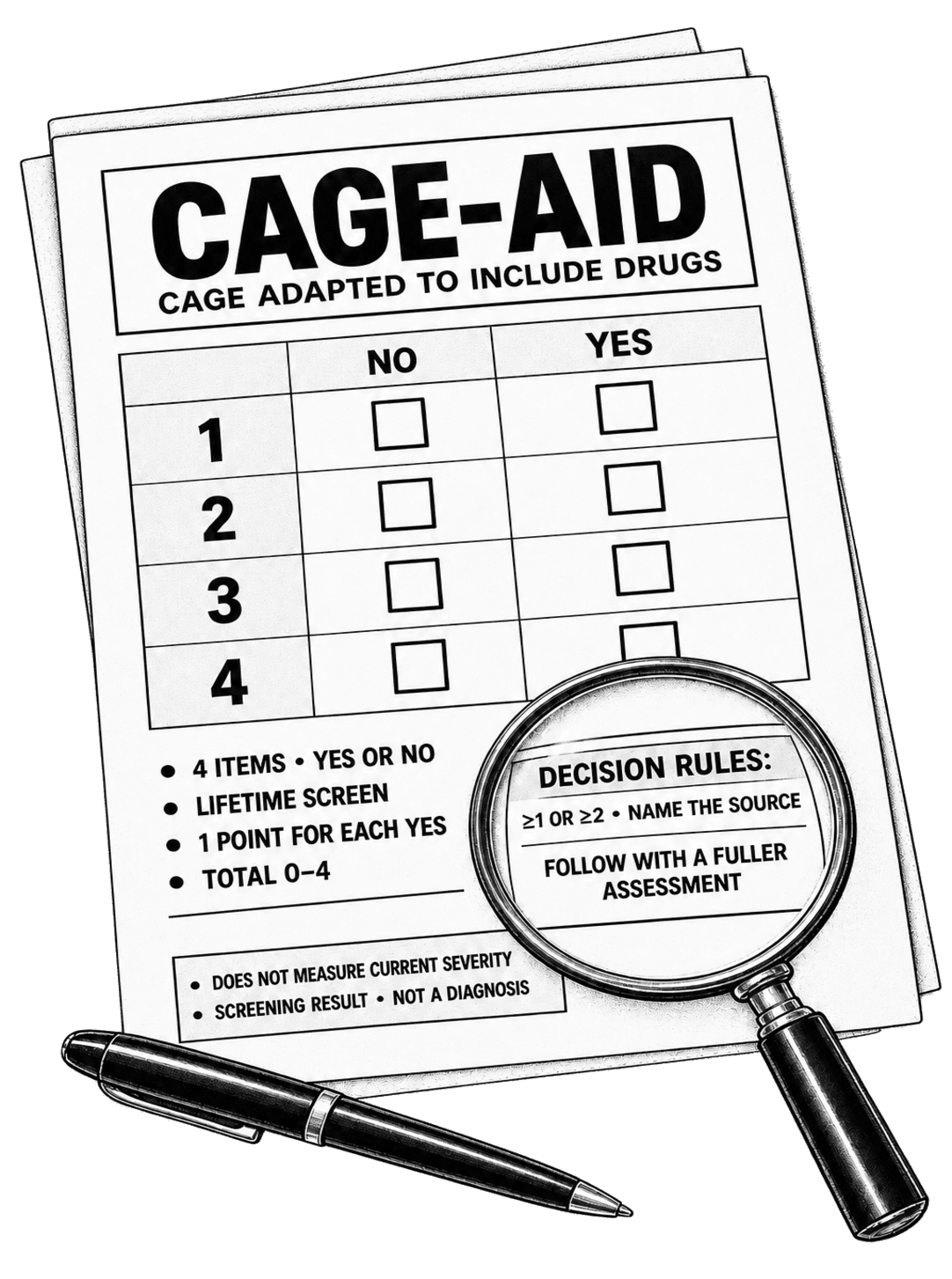
CAGE-AID is a four-item lifetime screen with a total from 0 to 4. SAMHSA TIP 42 treats one or more endorsements as a reason for fuller assessment, while a separate justice-system guide uses two or more; neither rule diagnoses an alcohol or drug use disorder or measures current severity.
Richard Brown and Linda Rounds introduced CAGE Adapted to Include Drugs in a 1995 primary care study, broadening the original alcohol-only CAGE to include drug-related warning signs.
Who it was designed for
The original study involved 124 adults attending an academic family medicine practice. CAGE-AID is now used in other healthcare and behavioral health settings, but one adult primary care sample cannot establish the same accuracy in every population.
Age, language, culture, setting, and the consequences of a positive result can affect which decision rule is appropriate. Services should choose a rule supported for their population and define the follow-up process before screening begins.
How it is administered
CAGE-AID uses four yes-or-no responses about lifetime experiences. It can be self-completed or asked by an interviewer.
Use the complete adapted form. The original alcohol-only CAGE and CAGE-AID are related, but they do not answer the same screening question. Complete all four responses before calculating a standard total, and do not treat a missing response as a negative response.
What it measures
The questionnaire counts broad warning signs associated with alcohol or drug problems. It does not ask how much or how often a substance is used, which substance is involved, or when the last use occurred.
Recency is not measured. An endorsement may describe a past experience rather than a current problem.
The DAST-10 is a longer, drug-specific screen focused on the past year. It does not combine alcohol and drug warning signs in the same way.
How scoring works
Each endorsed response scores 1, and each non-endorsed response scores 0. Add the four values for a total from 0 to 4.
No weighting is used. Higher totals mean that more warning signs were endorsed, but no severity bands are validated.
How to interpret a CAGE-AID score
The decision point depends on the screening purpose:
- One or more endorsements: SAMHSA TIP 42 uses this more sensitive rule to support a full assessment. It is intended to miss fewer possible problems, at the cost of more positive screens among people who do not have a current disorder.
- Two or more endorsements: a SAMHSA justice-system screening guide uses this rule to identify probable alcohol or drug problems. The higher rule is more specific, but it can miss some people who need follow-up.
These are source-specific screening conventions, not interchangeable diagnostic cutoffs. Report which rule was used and why.
What the score cannot tell you
CAGE-AID cannot show whether a problem is current, which substance is involved, or how severe the pattern is now. A score of 0 does not prove that alcohol or drug use is absent or safe.
Urgency is separate. The total cannot determine current intoxication, overdose risk, or whether withdrawal may need urgent medical care. It also cannot select treatment or replace a direct assessment of current use, health, functioning, and safety.
Evidence and limitations
In the original family practice study, lowering the positive-screen rule improved sensitivity and reduced specificity. That tradeoff helps explain why published guidance uses both one-point and two-point rules.
Neither rule is universal. Performance changes across populations, so interpret the count with the person's current circumstances and use a planned follow-up assessment to understand substances, timing, consequences, diagnosis, and safety.
Related assessment information
These pages cover related assessments. They may measure different constructs or use different populations and recall periods.
Register interest
Tell us which survey interests you. We will contact you if it becomes available on Survey Doctor.
Contact us