BRS: Brief Resilience Scale
What the six-item Brief Resilience Scale measures, how its 1-to-5 average is calculated, and why it has no universal score bands.
What this assessment is
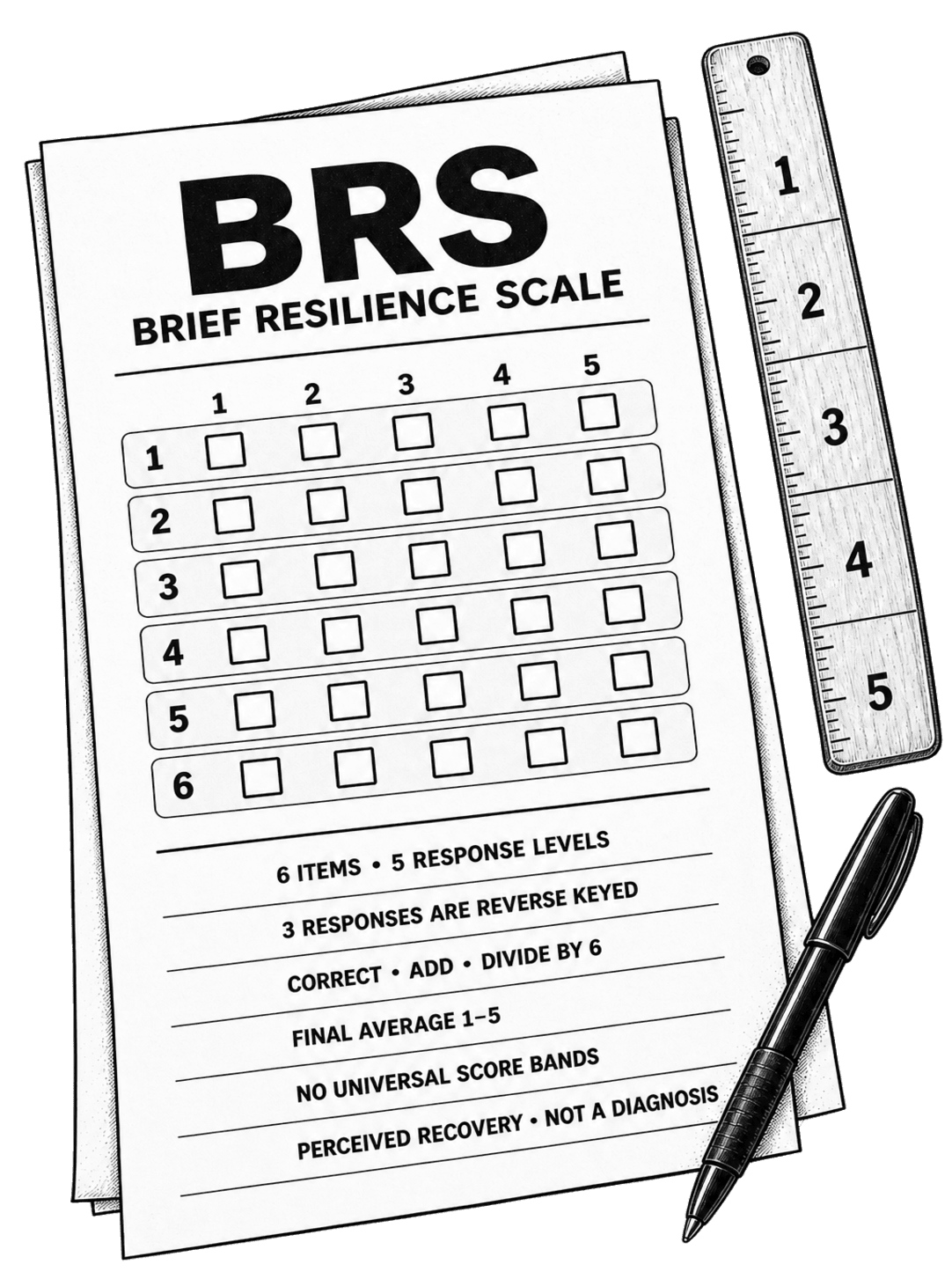
The six-item Brief Resilience Scale (BRS) produces an average from 1 to 5 after three responses are reverse scored. Higher averages reflect greater perceived ability to recover from stress. The result is not a diagnosis, and the original validation did not establish universal clinical bands.
Bruce Smith and colleagues introduced the BRS in a 2008 development study. They designed it to focus narrowly on perceived recovery after stress. Other resilience measures often combine coping skills, personal strengths, and social resources.
The BRS measures a person's view of their resilience. It cannot predict how that person will respond to every future event.
Who it was designed for
The original paper evaluated four samples: two groups of university students, cardiac rehabilitation patients, and women with fibromyalgia and healthy controls. Those samples do not create population-wide norms for every setting.
Age, health, culture, recent events, and the reason for assessment can affect results. When making comparisons, use evidence from a population that resembles the group being assessed.
How it is administered
The BRS is self-completed. It has six statements and five response levels. No fixed recall period is specified.
Use the complete form and a validated translation. Changing the wording, response scale, or timeframe creates a modified measure whose scores may not be comparable with published research.
What it measures
The BRS focuses on perceived recovery after stress rather than every resource that can support resilience.
It does not measure every part of resilience. It gives limited information about social support, practical resources, optimism, meaning, or specific coping strategies.
The CD-RISC-25 takes a broader approach. It covers several perceived resources linked with adapting under stress, while the BRS keeps a narrow focus on recovery.
How scoring works
Each response receives a value from 1 to 5. The published scoring material identifies three responses for reverse scoring. Add the six corrected values, then divide by six.
The final average runs from 1 to 5. Higher averages indicate a stronger perceived ability to recover from stress. No subscale profile is produced.
The published BRS scoring sheet uses an average rather than a summed total. A complete corrected sum runs from 6 to 30, but report the 1-to-5 average so the scoring convention is clear.
Use all six responses. The cited sources do not provide a validated missing-response replacement or prorating rule, so do not treat a missing response as zero or present an incomplete result as the standard six-response average.
How to interpret a BRS score
The 2008 validation study did not establish diagnostic cutoffs or universally applicable clinical bands. Interpret the 1-to-5 average as a continuous score.
A higher score means that the respondent reported more ability to recover from stress. It does not prove that the person will cope well in every situation.
For group comparisons, use norms from a relevant population and report the language, setting, and administration method so readers can judge whether the comparison fits. The cited sources do not establish one point change that proves meaningful improvement for every person or setting. Review repeated scores alongside changes in health, stress, and circumstances.
Avoid turning convenient online ranges into clinical categories unless a source has validated them for the population and purpose in question.
What the score cannot tell you
The BRS cannot identify why someone is finding recovery difficult. Do not infer cause from the total: symptoms, pain, illness, financial strain, and limited support can all affect recovery.
It also cannot measure immediate safety or determine whether treatment is needed.
A low average can support a conversation about current pressures and available support. It is not a diagnosis. A high average does not rule out serious symptoms or risk.
Evidence and limitations
The original study found expected relationships between the BRS and measures of coping, health, and stress in its four samples. Those findings support the intended recovery construct but do not make the score a clinical decision rule.
An independent Polish validation retained all six items and the same reverse-scoring method, but found separate wording factors for positively and negatively phrased items. Other translations and populations should be checked separately.
The scale's narrow focus makes the average easy to describe, but it cannot explain which personal or environmental factors support resilience.
Related assessment information
These pages cover related assessments. They may measure different constructs or use different populations and recall periods.
Register interest
Tell us which survey interests you. We will contact you if it becomes available on Survey Doctor.
Contact us