BAI: Beck Anxiety Inventory
What the 21-item Beck Anxiety Inventory measures, how its 0-to-63 total and common score bands work, and why physical symptoms need context.
What this assessment is
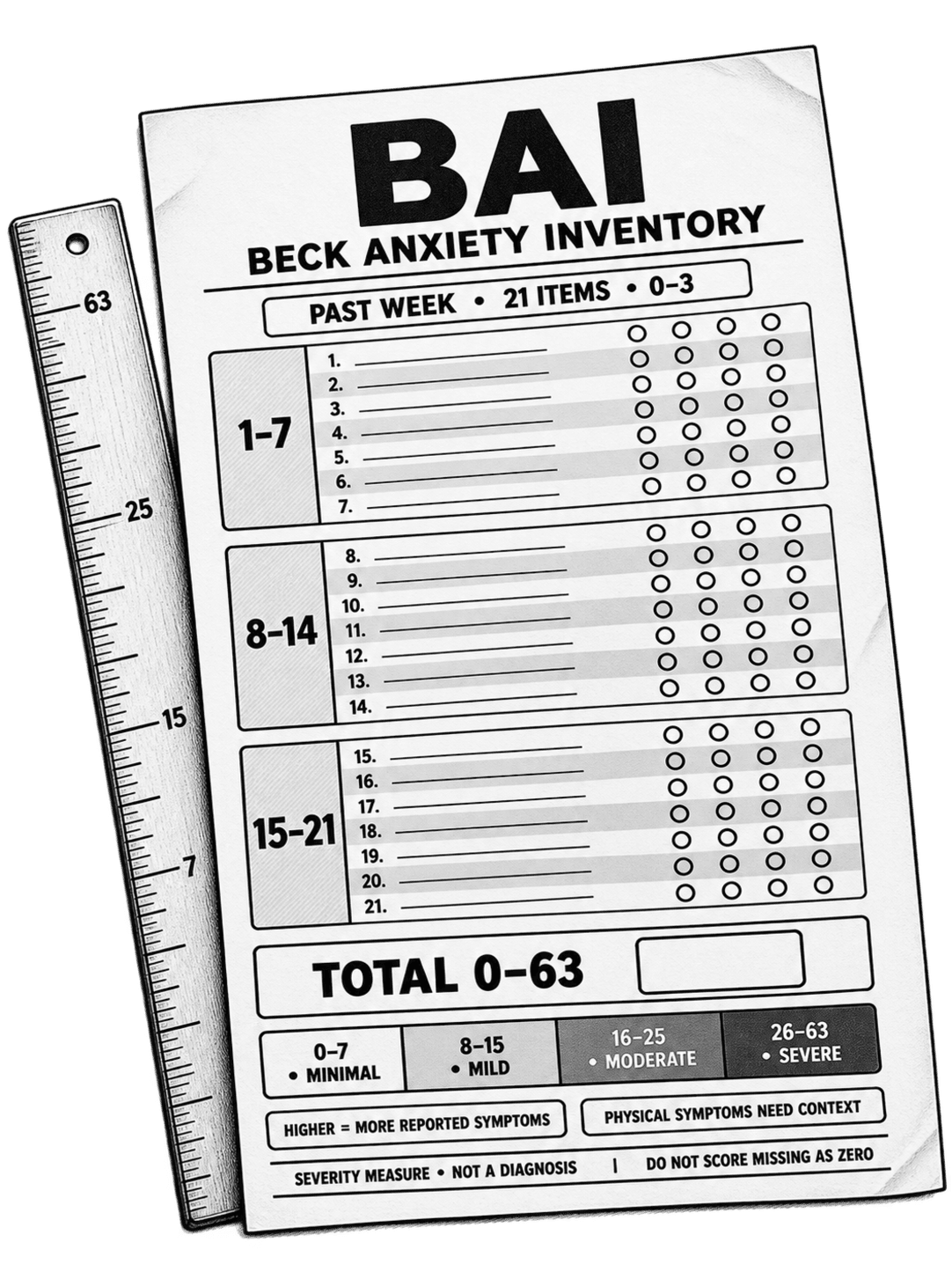
The Beck Anxiety Inventory, or BAI, is a 21-item self-report measure of anxiety symptoms during the past week, producing a total from 0 to 63. Four common bands describe reported symptom severity. They do not diagnose an anxiety disorder.
Aaron Beck and colleagues introduced the measure in a 1988 validation study. Pearson's current materials cover subjective, physical, and panic-related anxiety symptoms.
The scoring described below follows the 1993 BAI manual edition.
Who it was designed for
The current Pearson product record lists an age range of 17 to 80 years.
The BAI is used in clinical assessment and research, although its original evidence came from adult clinical samples rather than the general population.
Use outside the stated age range, or use of a translated or adapted form, needs separate evidence for that age, language, and population.
How it is administered
The BAI asks about anxiety symptoms during the past week or the past month, including today, depending on the version, and gives each item four severity levels, scored from 0 to 3.
It can be self-administered or presented verbally by a trained administrator. Pearson estimates five to ten minutes for completion.
Use the standard timeframe and response scale because changing either can make comparison with published scores unreliable.
What it measures
The BAI covers subjective anxiety, panic-related experiences, and physical symptoms, so it can record how anxiety feels in both the mind and body.
That emphasis also creates a limitation. The NINDS Common Data Elements record notes that physical symptoms can raise BAI totals in people with medical conditions. Illness and medication effects can resemble or add to anxiety, and a total cannot determine the cause.
How scoring works
Each response contributes 0 to 3 points, and all 21 values are added for a total from 0 to 63. No items are reverse scored.
Higher totals indicate more severe reported anxiety symptoms during the period the form asks about.
Pearson's Q-global guidance requires the response data needed for a report but does not publish a general replacement rule for missing answers.
Do not score a missing response as zero. Follow the scoring manual and the service's stated completeness rule.
How to interpret a BAI score
The common BAI score bands are:
- 0 to 7: minimal range
- 8 to 15: mild range
- 16 to 25: moderate range
- 26 to 63: severe range
The U.S. National Institute of Neurological Disorders and Stroke lists these bands in its Common Data Elements record.
These labels describe symptom severity and do not confirm that an anxiety disorder is present.
A score of 16 or higher is often used as a screening boundary. A 2025 Cochrane review found limited sensitivity at that boundary for detecting any anxiety disorder. Results also varied across settings and diagnoses.
Do not use one number as a rule-in or rule-out test.
What the score cannot tell you
The BAI cannot identify which anxiety disorder, if any, is present or separate anxiety from every physical condition, medication effect, sleep problem, or substance-related symptom.
It cannot choose treatment or establish urgency by itself. A proper assessment also reviews triggers, avoidance, function, health, medication, substance use, and clinical history.
Evidence and limitations
The original study found high internal consistency and support for separating anxiety from depression in the psychiatric outpatients who took part.
Pearson and NINDS both describe the BAI's emphasis on physical and panic-related symptoms, which requires care when medical conditions or medication effects may contribute.
The Cochrane diagnostic-accuracy review found substantial differences among studies and concerns about how participants were selected. Read the BAI as a severity measure within a wider assessment, not as a diagnostic test.
Register interest
Tell us which survey interests you. We will contact you if it becomes available on Survey Doctor.
Contact us